Understand the AI crisis. Find your community. Learn to organize.
Version 2026.10.0 · 2026-10-02
0 Start here
Summary
This handbook supports continuous training: learn the movement's approach, put it into practice, and return as your questions and responsibilities grow. Start with the welcome, learn where to find guidance and current records, then choose a way to get involved.
Continue with 1 DNA for the foundations and 3 Lead for everyday leadership practice. 2 Go deeper and 4 Train others set out the next learning modules; their pages are planned and still need to be written. 5 Supplemental gathers other planned practical topics. Staff-specific guidance lives in E Staff.
0.1 Welcome to Sapiens First
Summary
Sapiens First brings people together to fight for democracy, prosperity, and security in the age of AI. This handbook supports learning throughout your involvement: understand the movement, practice organizing, take responsibility, and help others learn. Start with a short reading path or return to the section that answers your current question.
0.1.1 Who we are and why this handbook exists
We want AI to serve the common good. Sapiens First organizes for democratic renewal, common prosperity, and a secure future through public participation and peaceful collective action.
The handbook gives people shared language, explanations, and practical guidance. Use it to understand our approach, find a contribution, and coordinate with others. Learn, try a useful next step, reflect with others, and return to the material as you grow. For the account of our purpose and approach, read 1.1 Story and 1.2 Strategy.
0.1.2 Who this handbook serves
The handbook is for supporters, members, volunteers, organizers, leaders, and paid staff. Reading a page does not require holding a particular role. People can use the material that helps with their questions and responsibilities.
Start with the basics. Every page opens with a Summary that gives what you need to act. Continue through a chapter for context, or jump to a numbered section when you need a specific answer. You don't need to read everything at once.
Open the details when you need them. Collapsible sections labelled For role holders or Background hold the extra depth.
Choose a reading path. The table above and 0.3.4 link to the numbered material. Return after a conversation, action, or training to review what worked and choose what to learn next. The reading paths are guides to learning, not restrictions on who may read a page.
Check what is ready. Planned pages name future modules; they do not yet provide a training curriculum. Drafts and pages under construction explain what is available and what still needs agreement.
Look up any term. The Glossary explains the words we use.
Find a specific answer. Use site search or Find anything. For current people, projects, and priorities, consult Atlas.
0.2 How the handbook works
Summary
The handbook explains durable concepts and guidance; live records hold current responsibilities and work. Numbered sections help you locate a topic, and status labels show whether material is adopted, proposed, or still being drafted. Editing or publishing a page does not adopt a policy.
0.2.1 Chapters, sections, subsections, and appendices
The handbook supports continuous training through six chapters: 0 Start here, 1 DNA, 2 Go deeper, 3 Lead, 4 Train others, and 5 Supplemental. Appendices A–E hold reference materials, further reading, citations, the glossary, and staff guidance. Start with DNA, then choose a deeper module, a leadership practice, or a training skill as your work calls for it.
Numbers show where a topic sits. 0 identifies this chapter; 0.2 identifies this section; 0.2.1 identifies this subsection. Appendix numbering follows the same pattern, such as A.1.2.
A chapter landing page summarizes the chapter and links to its sections. A section usually has its own page, with named subsections inside it. Each page has a Summary, a status, and a last-updated date. Summary and source lists are page elements, not extra numbered sections. The contents below read status directly from each page. Hover over a status symbol to see any note about unfinished material.
0.2.2 Beliefs, current practice, proposals, and open questions
Beliefs explain our outlook. They describe the reasoning and values behind our work. A belief alone does not establish a process, assign authority, or approve a new requirement.
Status shows adoption. An adopted page describes established guidance. Draft pages are unfinished material for review; proposal pages describe possible future practice; experimental pages describe trials; reference pages provide supporting material. Planned pages are outlines for future modules, awaiting review before content is filled in. Read the page's status and any qualifications before treating an instruction as settled. The status legend in the contents also distinguishes reference material from adopted guidance: both use ✅, with their full status on hover.
Labels show what isn't settled. A Proposal block describes a possible practice, with a dashed border so it can't be mistaken for current practice. A page that is still being written shows an Under construction banner at the top saying what is missing; read it as a starting point, not settled guidance. Publishing a page does not change decision rights or adopt its recommendations. Some practices are already in use; others are still taking shape as we prepare for more people to join.
0.2.3 Where authoritative information lives
Information lives in three places:
Information
Where to look
Durable definitions, expectations, and repeatable guides
The handbook, checking page status
Current roles, owners, governance, priorities, and work
The handbook explains; Atlas records. The handbook covers our shared concepts, expectations, and practices. Atlas is the source of truth for current governance, work, priorities, and owners.
The handbook tells you…
Atlas tells you…
What a role means
Who holds it now
How to plan a project
Which projects are live, and their records
How decisions get made
Who currently decides what
Source of truth
Atlas holds current roles, circles, projects, priorities, and owners. This handbook explains the concepts, expectations, and practices behind them.
For example, the handbook can explain a role; Atlas records who holds it now. An empty or unclear record does not imply that a decision has been made. Ask the relevant role holder when a current assignment or record is unclear.
0.2.4 How to suggest changes
If wording is confusing or information seems outdated, tell the person responsible for that area or suggest an edit. Identify the page, explain the problem, and include a source or proposed wording when you can. Repository contributors can follow the contributor guide.
Keep a factual correction or editorial change distinct from a proposed organizational decision. When suggesting a new rule, show what needs agreement and preserve its proposal status until the appropriate decision has been made.
0.2.5 Find anything
Common questions, routed to the page, or the Atlas record, that answers them. The handbook explains how things work; Atlas holds who is doing what right now. Can't find your question? Try the search box or the Glossary.
Sapiens First has a role for anyone, whatever time you have to give: stay informed, join an event, bring people together, or take responsibility for ongoing work. Start with a commitment you can keep, find the people already working on what you care about, and tell them if your availability changes.
0.3.1 First steps and finding a useful contribution
Why people get involved. AI raises questions that reach into ordinary life: how we earn a living, who makes decisions about us, and how we keep our communities safe. We call this the AI Crisis, and we believe these choices are too important to leave only to the people building and owning the technology. You don't need technical expertise to care about the outcome, and you don't have to become an organizer to be part of the response: staying informed, talking with people you know, and showing up all help. The first step below points to the full account.
Your first steps.
Get to know the movement. Read our story (the AI Crisis and the future we want), strategy (how we seek change) and culture (our values and red lines).
Join us. Use the Sapiens First website to find current ways to join and upcoming events. Explore the campaigns and choose an activity you can support.
Meet other people. Introduce yourself in the community space you're invited to. Share where you're based, what you care about, and how you'd like to contribute.
Choose a next step. Attend a gathering (often something simple, like a picnic or a town hall discussion, with room to get to know people; see A.2.6 Running gatherings), help with an activity, invite someone you know to get involved, explore the Fellowship (0.3.2), or talk to a role holder about work listed in Atlas.
Start with a commitment you can keep. Let people know if your availability changes.
For role holdersYour first week
Read your role's purpose and responsibilities in Atlas.
Confirm your priority project and who will support you.
Agree on what you can decide, what needs consultation, and what needs approval.
Get access to the tools and files needed for your work.
Arrange your check-ins and choose the first useful step.
Fellows should also follow the Fellowship pathway in 0.3.2.
A structured volunteer program: each Fellow takes responsibility for a project, with support from people working on related priorities.
The Fellowship is a structured way to contribute to Sapiens First. Each Fellow takes responsibility for a project that helps the movement, with support from people working on related priorities. You'll build skills in strategic analysis, planning, and leadership. You'll meet people working on AI and politics, help create something others can use, and have fun along the way. Every Fellow accepts the Fellowship agreement before starting.
What to expect. Fellows aim to contribute 5–10 hours a week during their program. The Fellowship is a volunteer program, not employment. Let your contact know if your availability changes.
Fellowship practice includes:
Discord for communication and coordination.
A standing weekly 1–1 with Rohan.
A team meeting or a written update memo every two weeks.
General meetings to learn about the movement and connect with other Fellows.
As the program grows, support may be assigned to other role holders. Check your onboarding instructions and current assignments in Atlas; don't assume that change has already happened.
Source of truth
Atlas holds current Fellowship assignments and support contacts. This page explains what the program involves.
Your first weeks.
Stage
What to do
What you should have afterward
Get oriented
Read the welcome pages, join Discord, arrange a check-in, and confirm a priority project
A project and someone to turn to for support
Scope
Define the audience, outcome, outputs, boundaries, and decision rights
A written scope reviewed with your project contact
Plan
Choose an approach, identify dependencies, and work backward from the deadline
A realistic plan with meaningful milestones
Make a first version
Create something useful early enough to get feedback
A draft, prototype, pilot, or initial result
Test and improve
Learn from users, colleagues, or other relevant evidence
A better result and clearer understanding of what works
Finish and hand off
Check success criteria, organize the work, and explain what comes next
Work another person can use or continue
Projects differ. Research, organizing, and software projects won't follow an identical calendar. Use your cohort schedule and agreed plan for actual dates. Each stage is explained in 3.2.6 Project execution and handoffs.
For role holdersPreparing for your first project conversation
Bring your interests, available time, and questions. Discuss who will use the result, why it matters, and what is achievable during the Fellowship. Use the scope template to capture what you agree.
If you're unsure how the project helps the mission, ask. Understanding the purpose makes good decisions easier as the work develops.
Keep people in the loop. If you can't complete an action item, attend a meeting, or need time away, let your team know. Share blockers while there's still time to help. A useful update says what changed, what you learned, and what you need next. See 3.4.5 Written updates and follow-through and 3.2.6 Project execution and handoffs.
After the Fellowship. You might continue as a Fellow, take on a coordination or leadership role, or use what you learned elsewhere. Discuss the next step with your contact and arrange a handoff if you're leaving a project.
Atlas describes a further engagement level for Fellows after three months and graduation; see 1.4.4 for how organizer role types fit together. Confirm the current progression process with your Fellowship contact.
0.3.3 Finding current people, projects, and contacts
Find people and work. Atlas is where you find who's responsible for the work you care about. It has views for roles, domains of work, and people: look up the work that interests you, then find the linked role or circle. That gives you a starting point for asking questions.
If nobody is listed, ask for help finding an owner. A missing assignment doesn't grant authority to commit the organization.
Source of truth
Atlas holds current roles, circles, and work assignments. Use it to find who's responsible for something today.
Stay in touch. Use whichever channel your group has agreed on. Groups agree their own communication channel; the Fellowship uses Discord for day-to-day communication and coordination, and some groups also use Signal. The website helps people find events and ways to participate. Email keeps supporters informed.
Keep project decisions and useful work somewhere others can find them, and link to them from the relevant work record. Protect passwords, member data, donor information, and private conversations. See 3.4 Facilitation for check-ins, written updates, and general meetings.
0.3.4 Where to start as an organizer
Organizers turn shared concerns into collective action, with clear responsibilities and support from one another.
An organizer is anyone taking ongoing responsibility for organizing. The lists below suggest a reading order: work through the earlier material when you need the foundation, or jump to the article that answers today's question. They don't define permissions or graduation requirements; current assignments and decision rights are recorded in Atlas.
Powerful AI may arrive soon, and we are organizing to shape its development before its effects become hard to reverse. We call our concerns the AI Crisis: concentrated economic gains, weakened democracy, and serious security risks. We want democratic renewal, common prosperity, and a secure future.
1.1.1 The AI Crisis
Powerful AI may arrive soon. Sapiens First is organizing to shape its development before its effects become hard to reverse. Three concerns guide our work:
Economic impacts. The benefits could concentrate among people who already hold wealth and power.
Democracy. AI could strengthen surveillance, autocracy, and other forms of concentrated power.
Security. Powerful AI could cause serious harm through misuse or loss of control.
We call this the AI Crisis. Our answer is to build the public participation and political power to shape what happens next.
These are the concerns that organize our work. We state them as our position, not as established research findings.
1.1.2 Tech oligarchs and concentrated power
This section is still being written. It will explain how ownership of powerful technology relates to political power. For the concern in brief, see 1.1.1 The AI Crisis.
1.1.3 The future we want
We imagine a world where AI serves the common good, and we organize to make that possible before powerful AI arrives. We believe in technology that uplifts all people, not just a rich few.
Our policy focus answers each concern:
Democratic renewal. Strengthen democracy to meet the challenges of AI.
Common prosperity. Share the gains from AI broadly.
A secure future. Govern AI so it doesn't cause catastrophic harm.
Find current recommendations on the policy page, and current work in Atlas. For how we pursue this future, see 1.2 Strategy.
1.1.4 Why Sapiens First exists
We believe these choices are too important to leave only to the people building and owning the technology. Our response is to organize while the future is still open to being shaped, and to bring people together to turn shared concerns into peaceful collective action.
We believe public participation and organizing capacity can help shape AI toward democratic renewal, common prosperity, and a secure future. Our approach is a repeating cycle: act, recruit, train. Each turn should help more people participate and lead the next turn. Growth and political progress are strategic aims; they are not guaranteed results of running activities.
1.2.1 Our theory of change
We believe the direction of AI can still be shaped through collective action. Community work brings people into relationships and shared activity. Invitations help them take on responsibility; training helps them organize and lead. Empowerment and advocacy turn that growing capacity toward political change.
The intended connection is between participation, capacity, and outcomes. An event can welcome people and create relationships, but attendance alone does not establish political influence. Our strategy needs to explain how those relationships support work toward the change we seek. Current campaigns, priorities, and owners belong in Atlas.
Each turn of act, recruit, train should bring in more people who can lead the next turn, compounding our capacity before powerful AI's effects become hard to reverse.
Source of truth
Atlas records the current mission structure, campaign priorities, and who owns them. This page explains the strategy and cycle behind that structure.
1.2.2 Act
Gatherings, outreach, campaigns, and peaceful actions give people something meaningful to do together. Choose an activity with a clear purpose and a useful next step for participants. Favor activities that help volunteers recruit more volunteers; that is a growth ambition we test in practice.
Recruitment grows through relationships, listening, invitations, and follow-up. Help someone find a next step that fits their interests and capacity. Joining an activity can lead to a small responsibility, then to helping others participate.
Training helps people practice organizing and leadership, receive feedback, and support others. The purpose is to grow the number of people who can carry responsibility for the next actions and invitations.
Use the training guide and feedback guidance. Look for what participants can do after training, including whether they can help someone else learn. Course completion alone does not show that organizing capacity has grown.
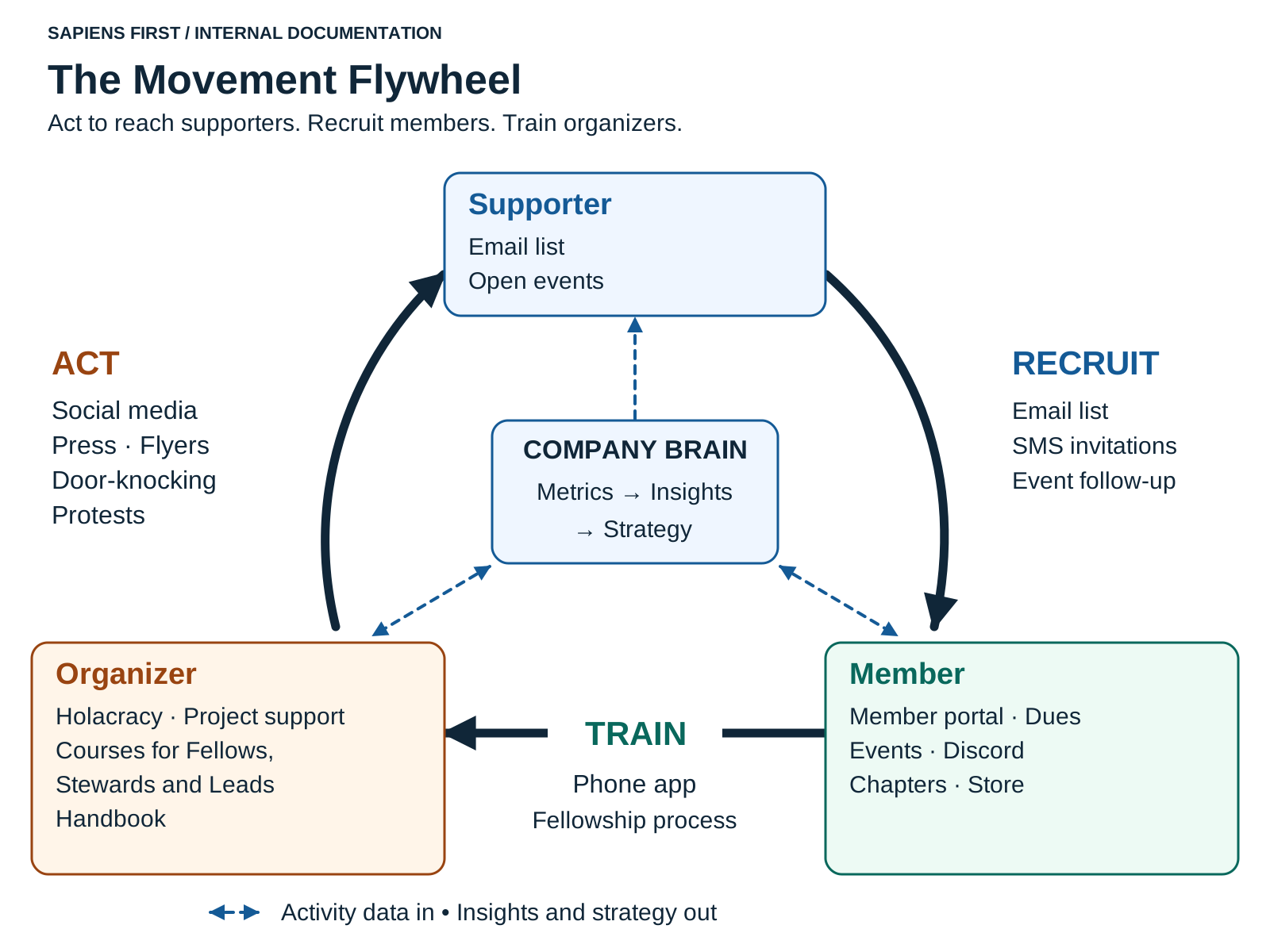
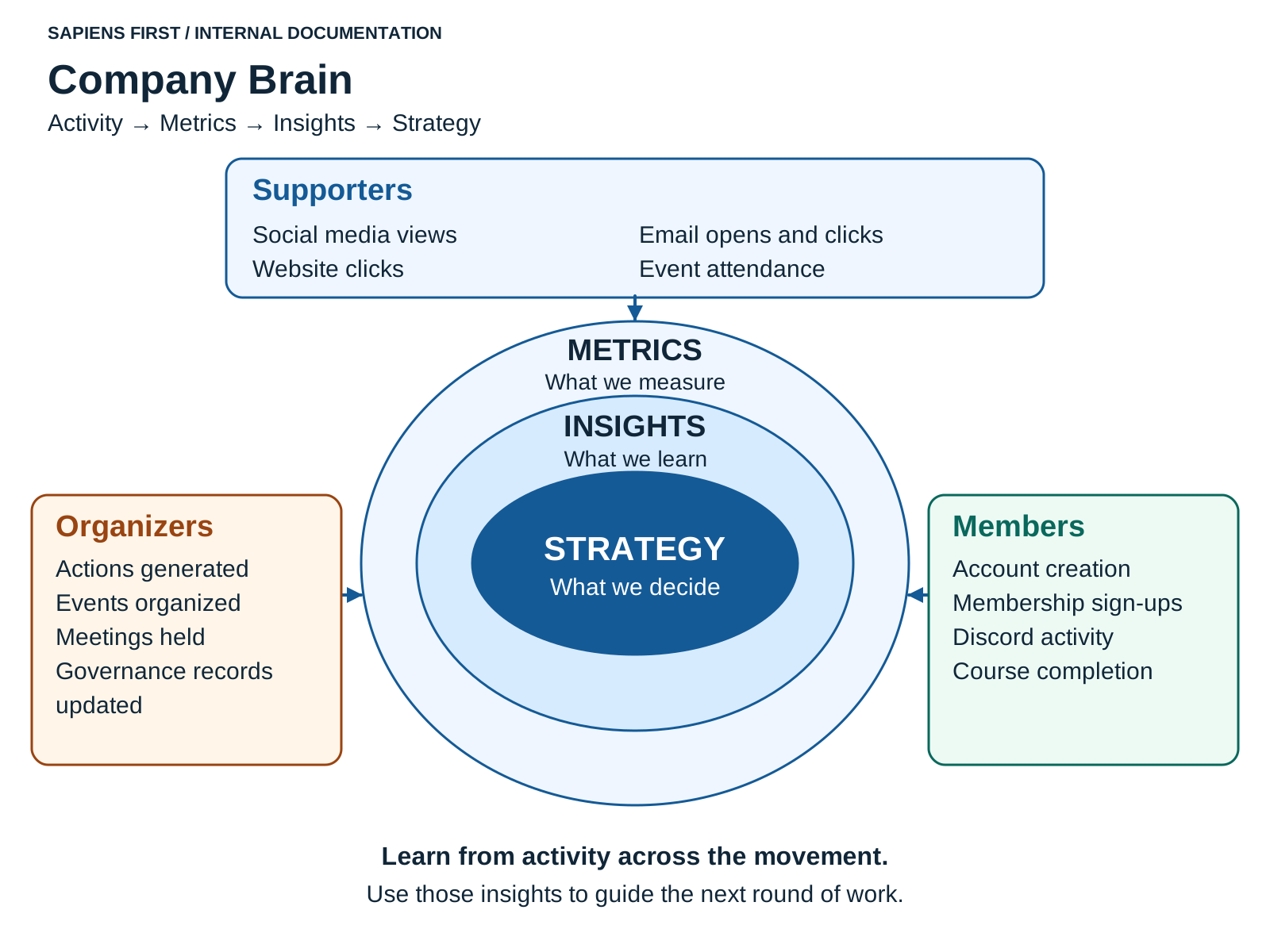
In text: actions reach supporters; invitations and follow-up help people become members; training and support help people become organizers. Those organizers can lead further actions and invite others into the cycle. Shared activity data can inform learning and strategy. The diagram's proposed channels and systems, including an app, courses, dues, and a company brain, do not establish that those tools or programs are available or adopted.
Act, recruit, train. Our approach is a cycle. Each activity feeds the next, so every turn brings in more people who can lead.
ab31b
Here's how it looks for one person. They come to an event and meet people. They take on a small responsibility. Soon they're helping the next person get involved.
How the work fits together. Three kinds of work build on each other:
Community builds participation and lasting relationships.
Empowerment gives people the knowledge and confidence to lead.
Advocacy turns that capacity toward political change.
Shared direction, governance, resources, and support hold it all together. Atlas records the current structure, including the pillars and the programs and work linked beneath the mission.
The cycle can compound when people stay involved, take responsibility, and help others lead. Recruitment without retention or support can leave the movement with more contacts and little additional capacity.
We aim for exponential growth. The cycle illustrates a possible mechanism for it, not a measured growth rate or a promise. For the proposed technical support, see E.4.1 Tech team: strategy primer.
1.2.6 Assumptions and strategic choices
Our strategy assumes that participation can become organizing capacity and that capacity can support political change. We need to check each connection against actual results. Political conditions, relationships, resources, retention, and leadership capacity can all affect what happens.
For a particular activity, state the intended outcome and the assumption connecting the work to it. If invitations increase but sustained participation does not, examine the invitation and onboarding approach. If more people complete training but few lead activities, examine what practice and support they need. These are examples of questions for learning, not adopted performance thresholds.
Our movement guide names mobilizing 3.5% of the population as an ambition. Treat a participation target as a strategic ambition, not a guarantee that reaching a percentage will produce political change.
Our growth depends on more than recruitment. Retention, leadership capacity, relationships, resources, and political conditions matter too. We need to test our assumptions and learn from actual results.
The Fellowship's initial strategy used a California campaign against mass surveillance, “Stop 1984!”, as a concrete starting point. The broader lesson is to choose work that matters, offers a plausible path to progress, and builds capacity for what comes next. Current campaign priorities belong in Atlas and the campaign pages.
Our core values are Peace, Wisdom, Deliberation, Respect, and Agency. They guide how we take initiative and work together.
1.3.1 Core values
Peace. We are peaceful activists. We do not harm people or property, or threaten to do so.
Wisdom. The fight for democracy is a marathon, not a sprint. We take care of ourselves and others.
Deliberation. We consider a range of tactics, disagree openly, and incorporate feedback.
Respect. We are kind, listen, and use nonviolent communication.
Agency. When we feel strongly, we take action.
1.3.2 Operating principles
Abundant leadership. Everyone can develop as a leader. Take initiative, think about strategy, and help resolve conflict.
Distributed responsibilities. Share responsibilities and make them clear so work doesn't depend on one person.
Tactical freedom. Within our values and agreed campaigns, teams can try different ways to advance the mission. Check decision rights before making commitments for the organization.
Collective learning. Test ideas, reflect on what happened, and share what others can learn. Written documentation helps useful knowledge travel.
1.3.3 Behavioral commitments and red lines
The following standards have one canonical home in A.1.1. They apply alongside the values above.
Leadership standards
People accepting formal responsibilities, including Fellows and staff, are expected to:
Take their responsibilities seriously and do what they say they will do.
Welcome feedback and listen to disagreement.
Care for the people they work with and use good judgment.
Share information and avoid becoming a bottleneck.
Put the success of the movement ahead of personal status.
Hand over or step down from a role when they can no longer fulfill it.
People acting in the name of Sapiens First must not:
Harm or threaten to harm people or property.
Bully, harass, intimidate, or discriminate against others.
Deliberately humiliate people.
Knowingly create serious risks for participants or the public.
Misrepresent Sapiens First's demands, values, activities, or relationships.
People who cross these lines may be asked to leave an event or step down from a role. They may also be asked to stop acting in the name of Sapiens First.
To report a concern, email rohan@sapiensfirst.org. Following a report, leadership interviews the parties involved and other relevant members before deciding next steps.
Members can hold different political views, participate in other organizations, attend outside events, and sign petitions in their personal capacity.
Sapiens First does not currently issue official candidate endorsements or coalition statements. Democratic chapter endorsements are a future possibility. Confirm any change in policy before representing an endorsement as official.
Apply the values to concrete choices. Before an action, consider risks to participants and the public. When a plan is contested, listen to the disagreement and explain the tradeoffs. When work depends on information you hold, share the context so others can act. If you can no longer fulfill a responsibility, arrange a handover rather than letting it become a bottleneck.
These examples explain the principles. Check decision rights before making organizational commitments. For practical conversations, see 3.1.1 Feedback culture.
1.3.5 What is distinctive about our culture?
Our culture pairs room for initiative with shared values, clear responsibilities, and collective learning.
Sapiens First organizes through roles and circles so people can act with context and purpose without depending on one leader. Atlas records the current structure; this page explains the concepts. Some parts are not settled yet: we have no adopted Holacracy constitution or process for changing the structure, and no agreed definitions for chapters and hubs.
This page answers three questions. What do we stand for? Our values set the boundaries for acting in the name of Sapiens First; see 1.3 Culture. Where do you fit? Everyone starts somewhere, and responsibility grows as you take it on; see 1.4.4 and 1.4.2. How do decisions get made? Know what you can decide, when to consult, and when to ask; see 1.4.2.
Find current roles, circles, and assignments in Atlas.
Source of truth
Atlas holds current roles, circles, and assignments. This page explains how they work.
1.4.1 Why Holacracy and distributed authority
The movement guide draws on Holacracy: explicit roles, distributed responsibility, and a process for addressing unclear or changing responsibilities. The aim is to let people act with context and purpose while reducing dependence on a single leader.
We have not adopted a complete Holacracy constitution or decision procedure. Use recorded decision rights and current agreements. Don't infer formal authority from the word "Holacracy."
1.4.2 Roles, circles, accountabilities, and decision rights
Roles. A role is a defined responsibility with a purpose, accountabilities, and a scope. People may hold multiple roles, and who fills a role can change without changing the responsibility itself.
Circles. A circle brings roles together around a shared purpose. A circle is a group of roles, while a program or product is an area of work; the two can be linked without being the same thing.
Decision rights. Every scope should mark choices as Decide (you choose alone), Consult (seek input, then decide), or Approve (someone else decides). The decision holder for a role or project should be recorded in Atlas.
Atlas holds current purposes, accountabilities, scopes, assignments, and linked work. The paragraphs below explain how to read a role in Atlas, how circles and work relate, how a role changes hands, and how to work through a decision.
Reading a role in Atlas. Clear roles help people act without asking one person for everything, and the responsibility should stay understandable when the person filling it changes. Atlas records each role through these fields:
Field
What it tells you
Purpose
Why the role exists
Accountabilities
Its ongoing responsibilities
Scope
The area of work described for the role
Privileges
Recorded access rights
Parent circle
Where the role sits in the organizational structure
Assignment
Who currently fills it
Linked work
Work the role is recorded as responsible for
Missing access details mean they haven't been documented. Linked work records responsibility; it does not by itself grant formal Holacracy authority or system access.
Source of truth
Atlas holds the current roles, circles, and who fills each one. This page explains what a role and a circle are and how to read them.
How circles and work relate. Atlas holds two related views: how responsibilities are organized (circles and roles), and how work contributes to the mission (programs, products, and projects).
This distinction helps when responsibilities change. A product can continue even when its owner or supporting circle changes. For the kinds of work records Atlas uses, see 3.2.1 From mission to work.
Taking on or handing over a role. Review the purpose, responsibilities, linked work, access needs, and available capacity with the person coordinating the assignment. Make sure Atlas reflects the current assignment.
When handing over, leave the next person the relevant files, context, open decisions, and next steps. Explain what needs attention soon. For what to leave behind when a project changes hands, see Finish and hand off.
Checking decision rights. Before starting work, agree on what you can decide, what needs consultation, and what needs approval. People need room to act and clarity about when to involve others. Your role and project scope are the starting points. Here's how to work through a decision:
6ucn4b
Consultation and approval are different. Be clear about which you're asking for and who will make the final decision.
Authority over a project is set in its scope, which names the owner and records which choices they decide, consult on, or need approved. Atlas records the current owner and decision holders. For the scope template, see Project scope.
Current practice for project decisions. Fellows (individual contributors; see 1.4.4) review project scope and plans with Rohan. Also discuss these with him where approval or a decision is needed: spending, public communications, external commitments, major scope or deadline changes, and important blockers.
As we distribute responsibility, record the actual decision holder in the role or project records. A change in the handbook's wording alone doesn't transfer authority.
1.4.3 Governance and changing the structure
A repeatable governance process for changing roles and circle responsibilities is a proposal, not yet adopted.
When responsibility is unclear. Describe the problem, the work it affects, and the decision you need. Raise it with the relevant role holder or circle contact. Keep a short record of the agreed resolution where others doing the work can find it.
If you can't identify the right person, ask your onboarding or Fellowship contact to help find them.
ProposalChanging roles and circle responsibilities
A repeatable governance process could let people bring a concrete tension, propose a change to a role or circle, consider effects on others, and record the agreed change in Atlas.
Before adopting this process, we need to settle who can approve changes, how disagreements are resolved, how decisions take effect, and who updates the record. Until then, follow the current decision rights and agreements.
1.4.4 Participation, responsibility, and employment
You can contribute in different ways at different points in your life; choose a level that fits your interests and capacity. Participation and role are different things. A program like the Fellowship describes participation. "Website Owner" describes a role. One person may hold more than one role.
Governance roles. A role is a specific responsibility. A role title alone doesn't establish permissions or authority.
Employment. Staff status is a separate concept from participation level and governance role. See E.0.4 What counts as staff?
Ways to participate. There are three main ways to participate: Supporter, Member, and Organizer.
Way to participate
What it involves
Supporter
Stay informed and join activities when you can
Member
Participate in the community, help with events, and build connections
Organizer
Take responsibility for work, from a project to leading other people; see the role types below
Check the current joining process for membership terms, dues, and eligibility. The handbook isn't a record of current prices or program dates.
Movement architecture. The movement architecture is a product roadmap for growing the movement. Each rung of the ladder of engagement has a definition, subcategories, and systems that recruit people onto it and keep them on it. Understanding it helps explain how we prioritize work: we build the systems that move people up the ladder.
Supporter
Member
Organizer
Defining feature
Email on the list
Registered as a member and paid dues at least once
Applied and accepted into a Course
Info we hold
Email, zip code
Email, address (line, city, state, zip code, country), full name, phone number
Media stunts; door-to-door; flyers; open letters; bought lists; event apps (Luma, Partiful); social media followers
Open events; membership free trial
Application
Retention systems
Emails
Discord; events; text reminders; email reminders; member-only events
Courses; coaching; app; socials
The ladder groups the ways to participate above. Atlas holds the current state of each system.
Source of truth
Atlas holds current membership terms, role assignments, and engagement levels. This page explains what each way of participating means.
Organizers and role types. "Organizer" is the umbrella term for people who take responsibility for work. Organizers hold one or more of three role types, defined in E.1 Expectations. You may still meet the older titles Fellow, Steward, and Lead; they map as follows:
Role types are not mutually exclusive positions or a managerial ladder: one person can hold more than one (E.1.4). A Fellow takes responsibility for a project through the supported volunteer Fellowship. "Steward" described a further engagement level for Fellows after three months and graduation, separate from any role with "Steward" in its title. A title alone doesn't establish permissions or authority.
Keep role and participation separate. Leading a team is a responsibility, not a requirement that everyone must progress toward. Continuing as an individual contributor can be a valuable choice.
For role holdersTaking on a role
Taking on a role means agreeing to its purpose and ongoing responsibilities. Discuss the time involved and the support you need before committing. Find your current assignments in Atlas and raise a mismatch if the record doesn't reflect your actual work.
1.4.5 Local circles and movement growth
Every local group starts as a circle. Hubs, chapters, and alliances are ideas for later stages of local growth; their definitions, thresholds, and procedures aren't adopted yet, so they aren't rules.
The handbook explains concepts; Atlas holds the live structure, including roles, circles, and assignments. Where the two differ, check Atlas for current assignments and raise the mismatch.
Atlas and AI: the proposed shared data system. The rest of this section describes where we're heading, not current features or requirements.
As we grow, keeping everyone informed gets harder. More chapters and projects usually mean more meetings, more reports, and more people whose main job is passing information along. We want to grow without that overhead growing at the same rate.
Our aim is for Atlas to give everyone a shared, current picture of the movement, and for AI to help us make sense of it. That means answering basic questions about the work, turning everyday records into metrics, and noticing what needs attention before someone has to ask. People should be able to act with context instead of waiting for it to reach them through layers of coordination.
Source of truth
Atlas records what currently exists: mission, work structure, roles, circles, and assignments. This section describes a proposed future, not Atlas's current features.
The questions Atlas should answer.
What are we trying to achieve?
Who is responsible for it?
What's happening?
Is it working?
What needs attention, and what should happen next?
Answering these needs four connected kinds of records:
Layer
Records
Answers
Organization
People, roles, circles, accountabilities
Who is responsible
Strategy
Objectives, key results, metrics
What we're trying to achieve, and whether it's working
Work
Programs, projects, tasks, events
What's happening
Learning
Tensions, suggestions, decisions
What needs attention and what to do next
When these are linked, responsibility is clear without anyone having to piece it together from documents. A key result links to a metric, the metric to the circle responsible for it, and the circle to the projects working on it.
Get metrics from the work itself. We want metrics to come from the ordinary records of doing the work, not from extra reporting. When someone signs up, attends an orientation, or joins a chapter, that step is already recorded somewhere. So is a project finishing or a role being filled. Atlas can calculate recruitment, retention, and project results from those records, so nobody has to count by hand.
These are records of organizational steps that people already expect us to keep. They aren't a way of tracking anyone's personal activity.
This also lets Atlas keep each metric's history. With a history, we can see trends instead of isolated numbers.
From a signal to a decision. Once Atlas knows what we're aiming for, who's responsible, and how the numbers are moving, AI can help us notice what needs attention sooner. Here's how that loop should work:
v7gdty
A metric moves outside its expected range.
Atlas raises it with the responsible role or circle as a tension: a gap between how things are and how they could be.
It suggests likely causes and possible next steps, with the evidence behind them.
The responsible people decide what to do.
We measure whether it helped, and learn from the result.
Example
Growth objective at risk. Sign-ups rose 50% over four weeks, but orientation attendance fell from 72% to 41%. Many new members waited more than three days for a scheduling link. Likely bottleneck: orientation capacity. Relevant role: onboarding lead. Possible next steps: make scheduling easier and add a second weekly session.
That's more useful than a red number on a dashboard. It points to a cause, a responsible role, and a next step, and it leaves the decision with people.
Recording tensions, decisions, and their results also builds a memory of what works. Over time, we can learn which approaches actually help.
Helping organizers do more. The purpose of AI here is to give organizers more time for the work only people can do: conversations, relationships, and leadership. It can help by:
Taking on routine follow-up people have agreed to hand over, like reminding a new sign-up to choose an orientation time.
Preparing a summary of the metrics and open tensions before a circle's review.
Drafting updates, plans, and handoff notes from existing records.
Suggesting where a role or circle could use more support.
We'll start with suggestions that people approve. Routine, low-risk tasks can move to automatic handling once we trust them. Decisions about people, priorities, and resources stay with people.
Know the limits.
AI helps us notice and understand. People make consequential decisions, especially about roles, commitments, and anyone's contribution.
Atlas shouldn't produce performance scores for individuals. A declining number prompts a check-in, as described in Metrics and people.
We only record what we need for the work, and we aim to be clear about what's recorded and why.
Private organizational information stays out of tools that aren't authorized for it.
BackgroundWhy this matters for how we organize
In From Hierarchy to Intelligence, Jack Dorsey and Roelof Botha argue that much of traditional management exists to move information. It collects context from below, relays decisions from above, and keeps teams aligned. They suggest AI can increasingly do that routing, leaving people to own outcomes and develop one another.
This fits the idea behind our roles and circles (1.4.2): distributed responsibility, explicit roles, and people acting with context rather than depending on a single leader. We're drawing on the idea, not adopting any particular company's structure.
Go deeper will help organizers examine the reasoning behind the DNA, test its assumptions, and practice explaining it. The proposed pages cover nonviolence, movement strategy, AI safety, and organizer conversations. Their scope and headings await Rohan's review before content is filled in; existing guidance remains linked from the outlines.
The authors' description of This Is an Uprising emphasizes strategic nonviolent action and how protest changes public debate. Momentum's public model connects mass protest with ongoing organization, including escalation, absorption, and distributed leadership. This supports reviewing the nonviolence and strategy outlines together, with attention to how new participants stay involved.
Momentum's public training videos introduce hybrid organizing through historical and contemporary movements. The four requested topics in the strategy outline are proposed headings, not a verified reproduction of Momentum's full curriculum. The AI safety page is a Sapiens First addition that needs its own evidence. This comparison was checked on 2026-10-09; Rohan's review of the outlines is still pending.
2.1 Why nonviolence works
Summary
This page will examine how nonviolent action can build participation, shift public support, and create pressure for change. It will distinguish strategic arguments from ethical commitments and assess the evidence and its limits. Start with the existing DNA strategy; the explanations and examples proposed here await Rohan's review.
2.1.1 Participation and public support
Planned; content will follow review of this outline.
2.1.2 Power, cooperation, and disruption
Planned; content will follow review of this outline.
2.1.3 Evidence, examples, and limits
Planned; content will follow review of this outline.
2.2 Strategy deep dive
Summary
This page will examine four tools for thinking about movement strategy: the S-curve, trigger moments, dilemma actions, and spectrum of allies. Each will need a clear explanation, an example, and limits on when it is useful. It will build on 1.2 Strategy and connect opportunities for action to welcoming and developing participants; Rohan's review is pending.
2.2.1 S-curve
Planned; content will follow review of this outline.
2.2.2 Trigger moments
Planned; content will follow review of this outline.
2.2.3 Dilemma actions
Planned; content will follow review of this outline.
2.2.4 Spectrum of allies
Planned; content will follow review of this outline.
2.2.5 Connect action to recruitment and training
Planned; content will follow review of this outline.
2.3 AI safety deep dive
Summary
This page will help organizers examine the AI-related claims behind 1.1 Story, separate evidence from uncertainty, and explain why those claims matter for our work. It will use the AI futures reading list as a starting point rather than treating movement strategy sources as AI evidence. Scope, sources, and proposed explanations await Rohan's review.
2.3.1 Claims and key terms
Planned; content will follow review of this outline.
2.3.2 Evidence and uncertainty
Planned; content will follow review of this outline.
2.3.3 Responses and the case for organizing
Planned; content will follow review of this outline.
2.3.4 Discuss questions and disagreements
Planned; content will follow review of this outline.
2.4 The organizer conversation
Summary
This page will deepen preparation, practice, and reflection around the organizer conversation. The existing five-step guidance stays in 3.3.1 The Organizer Conversation, with practical preparation and follow-up in the organizing conversations field guide. This outline proposes exercises and discussion around those sources; it does not replace them, and awaits Rohan's review.
2.4.1 Prepare using the existing guides
Planned; content will follow review of this outline.
2.4.2 Practice listening and inviting
Planned; content will follow review of this outline.
2.4.3 Reflect and agree on follow-up
Planned; content will follow review of this outline.
3 Lead
Summary
Leadership is a practice, not a job title. People in paid and volunteer roles lead when they take responsibility, help others contribute, and keep work moving toward the mission. This chapter turns the shared culture into everyday habits.
Sections
3.1 Culture in leadership — Give feedback, handle disagreement, take ownership, and model the culture.
3.2 Strategic planning — Connect the mission to objectives, metrics, projects, and review.
3.3 People — Hold organizer conversations, fit people to roles, and support growth.
3.4 Facilitation — Run tactical and governance meetings and follow through in writing.
Staff status is not a prerequisite for leadership. Current priorities and assignments live in Atlas.
3.1 Culture in leadership
Summary
Shared values become real in how leaders give feedback, handle disagreement, own their work, and set an example. This page covers the practices that exist today. 1.3 Culture holds the beliefs; the standards themselves live in A.1.1.
3.1.1 Feedback culture
Describe what happened and its effect. Ask about the other person's perspective. Agree on a concrete next step rather than leaving them with a vague judgment.
If a commitment wasn't met, understand what got in the way. The response may involve clearer scope, more support, a smaller commitment, or a change in responsibility.
Metrics can show where someone might need support, but they don't replace this conversation. See Metrics and people.
You learn through practice, support, and honest feedback. We want you to take responsibility and ask for help when you need it. For how people develop through responsibility, see 3.3.4.
3.1.2 Conflict resolution
Disagreement is part of Deliberation: we "disagree openly and incorporate feedback" (1.3.1). When a disagreement stays stuck, or a concern involves the person you would normally go to, you need a clear route.
For now, use the guidance on unclear responsibility and the reporting route in A.1.1 for conduct that crosses a red line.
3.1.3 Radical ownership
This section is still being written. In the meantime, the leadership standards in 3.1.4 set expectations for taking responsibility and handing work over. Check decision rights before committing the organization; a change in this handbook's wording does not transfer authority.
3.1.4 Modeling the culture
Leaders set the pattern others follow. The standards set expectations for reliability, openness to feedback, care, judgment, information sharing, and responsible handoffs. These standards apply to people accepting formal responsibilities, and they have one canonical home in A.1.1.
People accepting formal responsibilities, including Fellows and staff, are expected to:
Take their responsibilities seriously and do what they say they will do.
Welcome feedback and listen to disagreement.
Care for the people they work with and use good judgment.
Share information and avoid becoming a bottleneck.
Put the success of the movement ahead of personal status.
Hand over or step down from a role when they can no longer fulfill it.
Leadership also means making it easier for other people to contribute. Sharing context and handing work over well are part of that.
3.2 Strategic planning
Summary
Strategic planning connects the mission to the work people do this quarter and to the evidence that tells us whether it is working. This page carries the concepts and the practical methods: the mission-to-work records, objectives and metrics, strategic hypotheses, how projects are scoped, planned and handed off, a proposed weekly routine, and regular metric review. Copyable templates live in A.2.1. 1.2 Strategy holds the durable strategy and its assumptions.
Good work starts with a clear purpose. Before you take on a task, know three things: who it helps, what should change, and how it moves the mission forward. Learning runs as a loop: define what matters, observe what happens, reflect together, and change the next attempt (3.2.7). The handbook explains the approach; Atlas holds current work records. Proposals on this page need to be discussed and adopted before they become requirements.
3.2.1 From mission to objectives
Durable strategy and current priorities are different things. The theory of change and its assumptions belong in 1.2; current objectives, projects, and owners belong in planning and change as conditions change.
Every piece of work traces back to the mission through pillars, programs, products or services, and projects. Atlas records current work and who's responsible.
Source of truth
Atlas lists current mission, pillar, program, and project records and who owns them. This section explains the concepts behind those records.
From mission to work. Every piece of work traces back to the mission. Atlas uses these kinds of work records:
Kind
Plain-language meaning
Example
Mission
The overall change we are working toward
Political change around AI governance
Pillar
A major contribution to that mission
Empowerment
Program
Related work organized around a continuing purpose
Knowledge
Product or service
Something people can use or benefit from
A resource center or training offering
Project
A bounded effort to create or change something
Develop a workshop
The examples illustrate the concepts. Look in Atlas for current records and their relationships.
A product or service can need several projects over its life. Finishing a project doesn't necessarily end the responsibility to maintain what it produced.
Outcomes and outputs. Three terms keep plans honest:
An objective is a change. It describes what we want to be different.
An output is a thing. It's something we create.
A key result is the proof. It tells us how we'll recognize success.
Metrics calls that change an outcome, and adds input for an early, fast-moving measure of effort. A workshop is an output. Participants who can run their first meeting are the outcome. Both matter: we need to deliver the workshop, and find out whether it helps.
Each key result should point to a defined metric, so everyone reads it the same way. Track the outcome, and also the inputs a role can directly influence; 3.2.3 explains how.
ProposalConnecting objectives, products, and tasks
One proposal connects high-level priorities to products, milestones, tasks, and subtasks. Atlas already has a mission, pillar, program, product/service, and project structure. We should clarify the relationship between these before treating them as a single fixed hierarchy.
A useful starting proposal is:
Objectives describe the outcomes a piece of work should advance.
Products and services provide continuing value to defined users.
Projects create or improve those products, services, or other results.
Milestones mark meaningful progress or a decision point within a project.
Tasks describe specific next actions; subtasks help when a task needs breaking down.
Roles and circles hold responsibility for work and review the results.
Objectives may apply at more than one level. Whether they become separate Atlas records, fields, or linked records remains to be decided. Likewise, this proposal does not mean Atlas already supports task assignment or metric tracking.
Choose a useful next step. Work moves in a loop. Plan, act, review, and adjust the next round.
5qbdk
Find it. Locate the relevant work and its owner in Atlas.
Understand it. Learn the intended outcome and current priority.
Agree on it. Settle scope, success criteria, and decision rights.
Break it down. Split the work into milestones and concrete next actions.
Review it. Look at what happened and adjust the plan.
3.2.2 Objectives and key results (OKRs)
Start from objectives. An objective describes a change we want to achieve; key results tell us how we'll recognize progress (3.2.1 defines the terms). Each key result should point to a clearly defined metric, with a starting point, a target, and a date.
Example
Objective: Build a strong Berkeley chapter.
Reach 100 active members.
Reach 20 active organizers.
Keep 30-day member retention at 75% or higher.
Run four public actions a month.
"Active member" and "30-day retention" need agreed definitions before the key results mean anything. Two people reading the same number should understand the same thing.
Start with the outcome you care about. Then ask what you can observe, how you'll collect it, and what you would do differently after seeing the result. If no result would change a decision, you probably don't need the metric.
Treat this as guidance rather than an adopted OKR process: the planning cadence, and who owns and reviews each objective, are not settled yet.
3.2.3 Metrics
We use metrics to understand the health of the movement and to decide where to put our limited time, money, and attention. A metric is useful when it helps someone make a better decision; otherwise, don't collect it. Three ideas make that work: start from the objective (3.2.2), pair inputs with outcomes, and define each measure clearly.
Metrics come in three kinds: an input is an early, fast-moving measure a role can directly influence; an output is what gets produced; an outcome is the change that resulted. We track inputs and outcomes together, because inputs show where to act and outcomes show whether the work is succeeding.
Source of truth
The handbook defines what a metric means and how it should be read. Atlas holds each metric's current value and history, once it's built to store one; see 1.4.6 Atlas and AI.
Metrics describe the state of our work, not the worth of a person. They come from records the work already produces (sign-ups, attendance, roles filled, projects completed), not from monitoring what individuals do.
Inputs and outcomes. Most results come at the end of a chain. For recruitment, it might look like this:
Stage
Example
Effort
Organizer hours spent on outreach
Activity
Conversations started, events held
Output
Sign-ups and applications
Early outcome
People who attend an orientation and join
Outcome
Members still active after 30 days
Strategic outcome
Chapters that can sustain themselves and grow
The later stages matter most, but they're slow to move and depend on many things at once. The earlier stages are inputs: things a role holder can directly influence, and that show up quickly.
We track both. The outcome tells us whether the work is succeeding. The inputs tell us where to act. A recruitment lead can control how quickly new sign-ups are contacted; they can't personally guarantee that a chapter reaches 100 members.
Choosing the right input takes testing. If an input rises and the outcome doesn't follow, the input isn't measuring what matters. Revise it.
BackgroundWhy this matters
Hold people responsible for the things they can influence, and review outcomes together. That keeps attention on the work that moves results, and it keeps us honest about what depends on circumstances.
Pair your measures. A single number invites people to push on it at the expense of everything else. Pair each measure with one that shows the cost of overdoing it:
New members, paired with 30-day retention.
Events held, paired with attendance and follow-up.
Speed of responding to sign-ups, paired with how many go on to an orientation.
Projects completed, paired with whether they achieved their success criteria.
A project can be 90% complete and still not produce the result it was meant to. Measure both progress and effect.
Define a metric. Write the definition down once, then collect values against it over time. The definition stays stable; the observations build up into a history we can compare.
Field
What it explains
Name and purpose
What we measure and what decision it informs
Related objective
Which result it helps us understand
Type
Input, output, or outcome
Definition
The unit, population, period, and calculation
Data source
Where the values come from
Responsible role or circle
Who maintains it and explains changes
Review rhythm
How often it's worth looking at
Direction
Whether higher or lower is better
Baseline and target
Where we started and what we're aiming for
When to look closer
The level or trend that should prompt a conversation
Limits
What the metric misses or could misrepresent
Example
30-day member retention: the percentage of new members who are still active 30 days after joining. An outcome measure, owned by the membership role, reviewed weekly. Higher is better. Look closer below 75%; treat below 60% as urgent. It doesn't tell us why people leave. Conversations do.
Link each metric to the objective or area of work it measures, then link responsibility to the relevant role or circle. That keeps the meaning of the measure separate from whoever currently holds the role.
Specific definitions, targets, and results belong in Atlas or the live records linked from it. The handbook holds the approach. Atlas doesn't yet store metric definitions or history; see 1.4.6 Atlas and AI for where we're heading.
What we don't measure.
We don't track individuals' personal activity, messages, or online behavior.
We don't give people a single performance score.
We don't ask volunteers to fill out reports only to produce numbers. If a metric needs manual reporting, ask whether it's worth the time.
We don't collect data without a decision it's meant to inform.
When someone's work shows up in a metric, the purpose is to notice where support might help. See Metrics and people.
Models of movement growth.
ProposalModels of movement growth
We could model how recruitment, coaching capacity, active organizers, and chapters affect one another. A model could help us compare possible investments and identify constraints.
For example, more recruits may not lead to more active organizers if nobody has time to welcome and support them. More trained leaders may not produce more chapters without members and ongoing support.
Define each variable, the time period, the assumptions, and the evidence behind it. Compare the model's predictions with actual results and revise it. An “R0” for movement growth is an exploratory analogy, not an established metric or a guarantee of exponential growth.
3.2.4 Strategic decisions and hypotheses
Most plans start from what we already do and ask what to add next. That habit protects the status quo. Working backwards starts from the change you want. Then it asks what would have to be true to get there, a sharper way to choose which inputs deserve attention. Work backward from the outcome you want, state the assumption connecting the work to it, review the evidence, and adjust. 1.2.6 frames the organization-level assumptions.
Start from the outcome, not the activity. Pick the outcome first: a chapter that sustains itself, a steady stream of members still active after 30 days. Then work backwards to the inputs that could move it, instead of listing activities and hoping they add up to the outcome.
Inputs and outcomes already sets out the chain from effort to strategic outcome, and why we track inputs and outcomes together. Working backwards is how you pick which inputs belong on that chain. Choose the outcome, then ask what a role holder could change this week that plausibly leads there.
Treat strategy as a hypothesis. A strategy is a claim you haven't tested yet: if we change this input, then that outcome will follow. Write it down that way. It stops being a belief and becomes something you can check.
State the input and the outcome together. "If we cut time to first contact for new sign-ups, orientation attendance will rise" is testable. "Improve onboarding" is not.
Watch the outcome, not the input alone. An input can move for weeks without the outcome following. That's a sign the hypothesis is wrong, not a reason to look away.
Revise or drop what doesn't hold. A hypothesis that fails against the evidence has told you something useful. Change the input you're tracking, or change the plan.
ProposalWorking backwards, as a planning habit
This draws on the Working Backwards approach described by Colin Bryar and Bill Carr. It proposes a habit for setting strategy: write the outcome first, write the chain of inputs as a hypothesis, then commit to a review that checks whether it held.
A good input metric meets three tests:
The role can move it directly. Not full control over every factor around it; the actions that shift the number are theirs to take.
The link to the outcome is a stated assumption, not a settled fact. We believe moving this input helps the outcome. We test that belief against results and revise the input if it doesn't hold.
It rewards the real work, not a shortcut. A metric that's easy to game teaches people to chase the number instead of the outcome. This is Goodhart's Law: once a measure becomes a target, it stops being a good measure. What we don't measure sets out the limits we keep.
What still needs to be settled: which circles adopt this as a standing habit, how often a hypothesis gets reviewed, and where "if this, then that" statements get recorded in Atlas.
Working backwards asks a question before you build a metric at all: what outcome are we chasing? Everything in 3.2.3 Metrics and 3.2.7 follows from a good answer to that.
3.2.5 Project portfolio management
Projects are bounded efforts to create or change something. A project has a scope, a plan, and a defined hand-off; 3.2.6 explains how to scope and plan one. Guidance on selecting, sequencing, resourcing, pausing, and stopping projects across the whole portfolio is still being written; in the meantime, check decision rights before committing the organization.
Propose a new project. To propose a new project, write a scope using the project scope template, and check who holds decision rights for the area in Checking decision rights. Discuss the proposal with the relevant circle or role holder before investing heavily in an approach; who approves new projects isn't formally defined yet. Once it's agreed, record the project in Atlas.
3.2.6 Project execution and handoffs
Here's the shape that work takes, with room to loop back and improve before you finish. Execution runs from scope through plan, testing, and completion. A product or service can need several projects over its life, and finishing a project doesn't necessarily end the responsibility to maintain what it produced.
v87k2e
Copyable scope, plan, update, weekly plan, and handoff templates are in A.2.1 Planning templates.
Start with a scope. Write down the intended outcome, audience, outputs, success criteria, boundaries, constraints, and decision rights. Be explicit about what you're leaving out.
Discuss the scope with the relevant decision holder before investing heavily in a particular approach. Fellows (individual contributors; see 1.4.4) currently review this with Rohan. The scope names the project's owner and sets its decision rights: what the owner decides, where they consult, and who approves reserved decisions. Atlas records the current owner.
Use the project scope template. It is a starting point for agreement, not a form to fill out without discussion.
Choose an approach. Consider the important uncertainties and realistic alternatives. What do you need to learn? What could you try quickly? What depends on another person or team?
A useful strategy helps you make tradeoffs. For example: “Make it easy for a first-time organizer to use, even if that means covering fewer situations.” This is an example, not a movement-wide rule.
Build a plan. Work backward from the output, success criteria, and deadline. Identify meaningful milestones, then list the actions needed to reach each one. See the project plan template.
A milestone says what will be achieved: “Test the workshop with three new organizers” is clearer than “Testing phase.” A task starts with a concrete action: interview, compare, draft, schedule, review, or publish.
Plan around your real capacity and dependencies. Leave time for feedback, revision, and handoff. Don't add reports or presentations unless they help the project or are an agreed requirement.
For role holdersAdapt the process to the project
The Fellowship uses discovery, strategy, a first useful version, testing, iteration, and handoff as planning stages. They may overlap and adapt to the project. A research project might test a draft argument with readers; an organizing project might pilot one event; a software project might test a prototype.
Bring changes to major outputs or deadlines to the person who holds that decision. Make the tradeoff visible while there is still time to adjust.
Test and improve. Get feedback from the people the work is for. Check whether the result meets the agreed success criteria and whether your assumptions held up.
Separate essential changes from optional improvements. If the scope is too large, agree on what to reduce or defer rather than letting the deadline drift silently.
Finish and hand off. A project is ready to hand off when the agreed output has been reviewed against its success criteria and the next person can use it.
Share the finished work and any remaining limitations.
Organize files, decisions, and instructions.
Record the lessons someone else needs.
Identify any ongoing maintenance and who will take responsibility for it.
Agree on next steps and update the relevant work record.
Milestones are checkpoints, not automatically additional documents to submit. Keep documentation proportionate to what others need to continue the work. See the handoff template.
Weekly planning.
Proposal
The weekly review and task-writing guidance below are a suggested shared practice, not a new reporting requirement. Atlas does not yet assign weekly tasks.
A useful weekly plan connects your available time to the next important result. You should be able to tell what to do next and why it matters. The Fellowship uses project plans, check-ins, and updates; the routine below makes that work easier as more people join. For a one-page plan, see the weekly plan template.
A simple weekly review
Check your commitments. What did you agree to do? What is waiting on someone else?
Review the priority. What milestone or outcome matters most now?
Choose next actions. Pick specific actions that fit your available time.
Get the context. Link each action to the relevant project, instructions, and files.
Raise blockers. Ask for missing decisions or support early.
If priorities compete, make the tradeoff visible to the person responsible for coordinating the work.
Make tasks actionable
A useful task has an action, enough context to do it, and a clear stopping point. “Work on onboarding” leaves too much to work out; “Ask three new members where they got stuck during onboarding and summarize the answers” gives you a place to start.
Include the responsible person and a date when timing matters.
BackgroundGetting Things Done
We draw on Getting Things Done (GTD). The useful habit here is to capture commitments, clarify the next action, keep track of what you're waiting for, and review regularly.
Choose tools that support that habit. The handbook does not require a particular task app or a full GTD system.
3.2.7 Reviewing performance of the strategy
Collecting numbers is the easy part. The value comes from looking at them regularly, understanding what changed, and deciding what to do. Review the strategy through its metrics: what the numbers show, where the bottleneck is, and where resources should go.
A simple learning rhythm. Learning is a loop. Keep it simple enough that people actually use it.
zz851o
We want to get better at the work, and help others do the same. That means paying attention to results, welcoming feedback (3.1.1), and sharing what we learn. For the theory behind this approach, see the reading list on movements and our approach.
Give each level the view it needs. Not everyone needs the same numbers. Metrics should roll up from the work to the whole movement.
Level
Looks at
Example
Role
The inputs and outputs the role influences
Sign-ups a week, time to first contact, orientation attendance
Circle
The outcomes the circle is responsible for
New and active members, retention, organizer capacity
Movement
A small set of measures of overall health
Active members, active organizers, active chapters, retention, objectives on track
People coordinating the whole movement shouldn't need to inspect every project. They should see the overall state of the work, then follow a number down to the circle, role, and records behind it when something looks wrong.
Keep the top-level set small. If everything is a priority, nothing is.
A regular review. This is a suggested practice while we settle how circles review their work. A short review every week or two, with a clear focus, is a good starting point.
Look at the trend, not just the latest value. Compare with previous weeks and the same point in past campaigns.
Focus on what changed unexpectedly. Skip what's on track. Spend the time on the surprises.
Ask the responsible role to explain. They know the context. "I don't know yet" is a fine answer, as long as someone follows up.
Decide what to do. Keep going, change an approach, move resources, or ask for help. Record the decision and who owns it.
Check the metric itself. If a number misled us, fix the definition.
This review is for learning, not for defending numbers. A bad week that's understood is more useful than a good week nobody can explain.
BackgroundNumbers and stories
When the numbers and people's experience disagree, investigate. Often the experience is pointing at something the metric misses. Talk to the people involved: a few conversations can explain a trend that no dashboard will.
Find the bottleneck. Metrics are most useful for deciding where effort will make the biggest difference. Look along the chain for the stage that's holding everything else back.
For example:
Week 1
Week 2
Week 3
Week 4
Sign-ups
28
31
37
42
Orientation attendance
72%
69%
52%
41%
30-day retention
78%
76%
73%
71%
Recruitment is going well. The problem is what happens next. If new members wait days for an orientation invitation, more outreach won't help. A second orientation session or faster scheduling will.
Catch problems at the earliest stage you can. It's easier to fix a scheduling gap this week than to explain a retention drop next month.
Allocate resources. Our time, money, and attention are limited. Metrics help us put them where they'll do the most good:
Support the stage or group that's holding back the rest.
Invest more in approaches with evidence that they work.
Stop or reduce work that isn't producing its intended result.
Protect the capacity that growth depends on, like people who welcome and train new members.
A number moving in the right direction doesn't automatically prove that our work caused it. Check the context, the quality of the data, and what else changed.
Metrics and people. A falling number is a reason to have a conversation, not a verdict about a person.
Suppose someone's weekly outreach falls from 24 to 19, then 11, then 6. That's worth noticing. The right response is a check-in. They may have exams, the target may be unrealistic, the role may be poorly designed, or they may need support.
Use metrics to see where help is needed. Use conversations and feedback to understand people's contributions. Outcomes depend on resources and circumstances outside anyone's control, so don't judge a person by a result alone.
Avoid common pitfalls.
Measuring what's easy instead of what matters. Counting posts is simpler than knowing whether anyone joined because of them.
Chasing the number. When a measure becomes a target, people can hit it without achieving the purpose. Pairing measures helps.
Too many metrics. A handful that people actually review beats dozens nobody reads.
Reporting for its own sake. If nobody makes a decision with a number, stop collecting it.
Treating completion as success. Finishing a project isn't the same as achieving its outcome.
3.3 People
Summary
Leading well means helping the right people take on responsibilities they can grow into. This page covers the conversation that invites people in, how to think about fit and growth, and how volunteers are welcomed and developed. Practical how-to detail stays in the field guides, which are linked below.
3.3.1 The Organizer Conversation
A good conversation moves through five steps, from first contact to a clear next step.
Connect. Introduce yourself and ask an open question about what matters to the other person.
Listen. Give them room to explain their concerns and experience. Resist the urge to turn the conversation into a speech.
Find common ground. Connect their concerns to a relevant part of the movement's work, without pretending you agree about everything.
Invite. Offer a concrete next step, such as a gathering or introductory meeting.
Follow up. If they want further contact, agree on how and when.
This section is still being written. It will set out how we think about people's strengths and how they develop, and how that shapes the way we lead.
3.3.3 The right people in the right roles
Roles describe the work; people take them on and hand them over. For what roles and circles are, how to read them in Atlas, and how a role changes hands, use 1.4.2 Roles, circles, and decision rights and Taking on or handing over a role. Live assignments stay in Atlas. Guidance on judging fit between a person and a role is still being written.
3.3.4 Supporting growth without assuming rapid transformation
A next step might be running part of a meeting, completing a project, supporting another Fellow, or coordinating a team. Choose something that stretches your skills while fitting your capacity.
Honest feedback goes with this; see 3.1.1. Leadership also includes making it easier for other people to contribute; see 3.1.4.
ProposalRole-specific development rubrics
Rubrics could be written for Fellows, managers, engineers, and other roles. A useful rubric would define observable expectations for the actual responsibility, with examples of good work and the support available.
Possible dimensions include quality, reliability, judgment, collaboration, and helping others develop. These are starting points for discussion, not a scoring system.
Before adoption, define who reviews whom, what evidence is used, how feedback is discussed, and what decisions the review affects. Separate a project's results from judgments about an individual's contribution: outcomes can depend on resources and circumstances outside their control.
Draft rubrics for the Individual Contributor, DRI, and Player-Coach role types already exist; see E.1 Expectations.
3.3.5 Recruiting and developing volunteers
Welcoming participants, following up, training, and handing over sustainable responsibility already have practical guides:
Train.Training organizers, which starts from a concrete outcome and lets people practice.
Follow up. The conversation guide notes that recruitment is only the beginning: make sure someone can welcome the people who respond.
3.4 Facilitation
Summary
A good meeting has a purpose, a facilitator, and a clear record of what was decided. This page covers the facilitation practices we use today. 1.4 Structure explains distributed authority; the practical meeting formats are in 3.4.4 and 3.4.5 below.
3.4.1 What facilitation is for
Facilitation helps a group reach a result it could not reach alone. It covers purpose, preparation, participation, timekeeping, and clear outputs.
State the purpose and prepare an agenda.
Give someone responsibility for facilitation and someone responsibility for recording decisions.
Make room for people who haven't spoken.
Distinguish discussion from an actual decision.
End with next steps, owners, and any dates that matter.
For a learning session, keep presentation time short enough for discussion and practice. For a project meeting, focus on the questions that need the group.
For a simple structure to run a check-in or general meeting, see 3.4.4.
3.4.2 Tactical meetings
A tactical meeting is a regular meeting where a circle coordinates its current work. We haven't yet agreed a general format; the Holacracy format is one candidate, and we may adapt it. The tech team already runs its own version as part of its two-week sprint cycle; the general agenda will live in A.2.3.
Existing Fellowship check-ins and general meetings are not automatically Holacracy tactical meetings. See 3.4.4.
3.4.3 Governance meetings
A governance meeting is where a circle processes tensions and changes its roles and policies. For why the organization works this way and what is currently proposed, see 1.4.3 Governance and changing the structure. No general format or authority has been adopted yet; the tech team's governance meeting is a working example, and the general agenda will live in A.2.4.
Until a format is adopted, follow the current decision rights and agreements. A change in this handbook's wording does not transfer authority.
3.4.4 Choosing the right meeting
Different meetings serve different purposes. Three are in regular use.
Project check-ins. Discuss progress, decisions, blockers, and support.
General meetings. Connect people and build shared understanding of the vision.
Gatherings. Help people connect and take a next step. See Gatherings.
Project check-ins. Use a check-in to discuss progress, decisions, blockers, and support. Circles can also hold a short metrics review. Share the relevant work beforehand when possible. Leave knowing what happens next and who is responsible.
Fellowship practice includes weekly 1–1s with Rohan and either a team meeting or a written update every two weeks. Your current program instructions hold the actual schedule. For one-to-one meetings, see the external guide Running 1–1 meetings.
General meetings. General meetings help people connect, understand the movement, and discuss the vision and theory of change. They can include short teaching, small-group discussions, and a chance to share projects. They are not for project decisions.
Tactical and governance meetings (3.4.2, 3.4.3) are separate. For a full meeting cycle in practice, including 1:1s, an all-hands, and a demo day, see the tech team's two-week sprint cycle.
3.4.5 Written updates and follow-through
A useful update covers:
What you completed and learned.
Links to the work or evidence.
Risks, blockers, or decisions needed.
What you plan to do next.
You don't need to narrate every task. Help the reader understand the state of the work and where they can help.
Keep agendas and notes with the current meeting records. The handbook holds the repeatable format; dated agendas are records of particular meetings. Record decisions and commitments where the people doing the work can find them, as in when responsibility is unclear. For a template, use the project update template.
4 Train others
Summary
Train others will help organizers turn handbook material into sessions that people can use and other trainers can repeat. Its six proposed pages expand A.2.9 Training organizers, which remains the existing practical guide to learning through practice. Scope and headings await Rohan's review before detailed agendas, exercises, or trainer expectations are written.
Momentum's public training videos connect mass training with bringing in participants and developing leadership. Its 2023 trainer cohort description includes training for trainers, preparation with partners, coached practice, debriefs, and continued shared learning. These are useful comparisons for the training-trainers and follow-up outlines, not current program requirements for Sapiens First.
The authors' description of This Is an Uprising presents nonviolent organizing as a craft rather than a spontaneous eruption. Our proposed training chapter will need to connect practice to that organizing purpose. Adult teaching methods, detailed exercises, facilitation, and logistics remain proposed expansions of A.2.9, not claims that the book or Momentum supplies our six-page structure. Sources were checked on 2026-10-09; Rohan's review is still pending.
4.1 Designing an agenda
Summary
This page will expand A.2.9 Training organizers from choosing a concrete outcome to planning a timed session. It will propose ways to sequence explanation, examples, practice, and reflection, and to prepare an agenda another trainer can use. Specific formats and examples await Rohan's review.
4.1.1 Choose the learning outcome
Planned; content will follow review of this outline.
4.1.2 Sequence explanation, practice, and reflection
Planned; content will follow review of this outline.
4.1.3 Plan time and prepare a reusable agenda
Planned; content will follow review of this outline.
4.2 Teaching adults
Summary
This page will expand A.2.9's guidance on relevant material into ways to teach people with different experience and responsibilities. It will propose methods for drawing on participants' knowledge, making ideas understandable, and checking whether they can use what they learned. Teaching methods and examples await Rohan's review.
4.2.1 Understand participants' experience and needs
Planned; content will follow review of this outline.
4.2.2 Connect ideas to useful practice
Planned; content will follow review of this outline.
4.2.3 Check understanding and adapt
Planned; content will follow review of this outline.
4.3 Role-plays and simulations
Summary
This page will expand A.2.9's explain, show, try, and reflect sequence into guidance for designing role-plays and simulations. It will propose exercise briefs, participant roles, and debrief questions that connect practice to an organizing skill. Exercises, participation arrangements, and examples await Rohan's review.
4.3.1 Choose a skill and scenario
Planned; content will follow review of this outline.
4.3.2 Prepare roles and participation
Planned; content will follow review of this outline.
4.3.3 Debrief and try again
Planned; content will follow review of this outline.
4.4 Facilitating a room
Summary
This page will expand A.2.9 Training organizers into guidance for keeping a training session participatory and useful. It will propose ways to introduce activities, support discussion, manage time, and respond when people struggle; existing meeting guidance stays in 3.4 Facilitation. Training-specific methods and examples await Rohan's review.
4.4.1 Open the session and explain activities
Planned; content will follow review of this outline.
4.4.2 Support participation and discussion
Planned; content will follow review of this outline.
4.4.3 Respond to difficulty and adjust time
Planned; content will follow review of this outline.
4.5 Training trainers
Summary
This page will expand A.2.9's guidance on sharing agendas, examples, and lessons into preparation for people who will teach others. It will propose rehearsal, observation, feedback, and support as trainers take on more responsibility. Trainer expectations and development arrangements await Rohan's review.
4.5.1 Prepare with the agenda and source material
Planned; content will follow review of this outline.
4.5.2 Rehearse, observe, and give feedback
Planned; content will follow review of this outline.
4.5.3 Share responsibility and keep improving
Planned; content will follow review of this outline.
4.6 Logistics and follow-up
Summary
This page will expand A.2.9's guidance on improving training into preparation and follow-up around a session. It will propose coordination of materials, participation needs, next steps, and lessons for the next training, while current schedules and assignments stay in live program records. Checklists and follow-up arrangements await Rohan's review.
4.6.1 Prepare people, materials, and the setting
Planned; content will follow review of this outline.
4.6.2 Agree on participants' next steps
Planned; content will follow review of this outline.
4.6.3 Collect feedback and hand over lessons
Planned; content will follow review of this outline.
5 Supplemental
Summary
Supplemental sections cover practical topics that some organizers will need but that sit outside the core chapters. All four pages are planned stubs; each lists what it needs to cover. No guidance in this chapter has been written or adopted yet.
5.1 Fundraising — How Sapiens First raises and stewards money.
How the political activity and representation rules in A.1.1 apply to public statements.
Crisis and correction procedures.
5.4 Running for office
Summary
Guidance for organizers considering elected office.
5.4.1 What this section will cover
Whether and how Sapiens First supports organizers who run for office.
How candidacy interacts with organizer roles, staff employment and the representation rules in A.1.1.
Legal and nonpartisanship constraints by country.
Resources, training or endorsements, if any.
A Reference materials
Summary
Reference materials hold reusable policy text, rubrics, templates, agendas, prompts, and style guides. Each item has one canonical home here; the main chapters explain how to apply it and link back. Pages marked under construction say at the top what they're still missing.
Organizing field guides by stage. A.2.6 to A.2.10 are repeatable, practical guides for organizing locally, grouped by the act, recruit, train cycle: act together, recruit new people, and train others to lead. Start with one activity you can do well, invite others to help, learn from the experience, and share what worked.
Act: bring people together.A.2.6 Gatherings help people connect and take a next step; A.2.7 Peaceful actions help you choose and plan an action that serves the campaign.
A.1.1 Values-related standards, red lines, and reporting
Summary
These standards apply to people acting in Sapiens First's name and people accepting formal responsibilities. A fuller reporting process, including a route for concerns that involve the usual contact, is still being developed.
Leadership standards
People accepting formal responsibilities, including Fellows and staff, are expected to:
Take their responsibilities seriously and do what they say they will do.
Welcome feedback and listen to disagreement.
Care for the people they work with and use good judgment.
Share information and avoid becoming a bottleneck.
Put the success of the movement ahead of personal status.
Hand over or step down from a role when they can no longer fulfill it.
Red lines and reporting
People acting in the name of Sapiens First must not:
Harm or threaten to harm people or property.
Bully, harass, intimidate, or discriminate against others.
Deliberately humiliate people.
Knowingly create serious risks for participants or the public.
Misrepresent Sapiens First's demands, values, activities, or relationships.
People who cross these lines may be asked to leave an event or step down from a role. They may also be asked to stop acting in the name of Sapiens First.
To report a concern, email rohan@sapiensfirst.org. Following a report, leadership interviews the parties involved and other relevant members before deciding next steps.
Political activity and representation
Members can hold different political views, participate in other organizations, attend outside events, and sign petitions in their personal capacity.
Sapiens First does not currently issue official candidate endorsements or coalition statements. Democratic chapter endorsements are a future possibility. Confirm any change in policy before representing an endorsement as official.
A.1.2 IC expectations rubric
Summary
An Individual Contributor (IC) directly creates value through their craft. This draft assesses Output, Communication, and Judgment. A rating of 3 means fully meeting expectations: successful performance in the role. The rubric preserves the complete criteria supplied on October 2 and has not yet been adopted as policy.
Role and scope
The core question is:
How effectively do you produce excellent work?
This rubric evaluates the work a person produces as an IC. Define the agreed work, expected pace, and quality before evaluating it.
Roles can overlap. Evaluate the roles a person actually held during the review period; IC, DRI, and PC do not form a required promotion ladder.
Expectations rubric
The three dimensions are Output, Communication, and Judgment. Ratings describe the overall pattern of contribution and supporting evidence, rather than a checklist to maximize mechanically. A 4 or 5 represents meaningfully greater contribution, scope, or leverage than reliably fulfilling the expected role.
Rating
Output
Communication
Judgment
5 — Extraordinary
Repeatedly delivers major, high-quality systems or products that materially expand organizational capability. Creates tools or automation that multiply future output and handles highly ambiguous technical problems independently.
Creates exceptional clarity with very little overhead. Anticipates information needs, surfaces risks early, documents consequential decisions, and substantially reduces coordination costs.
Consistently identifies important problems or opportunities before they are assigned. Reframes problems, finds substantially higher-leverage solutions, and makes excellent product and technical tradeoffs under uncertainty.
4 — Exceeds expectations
Consistently ships high-quality work faster or at greater scope than expected. Owns substantial projects end-to-end, improves underlying systems, and creates reusable leverage.
Proactively communicates progress, reasoning, blockers, results, and next steps. Anticipates questions, closes loops, and raises issues before they become problems.
Frequently improves the proposed approach. Prioritizes effectively, challenges weak assumptions, simplifies systems, and notices important downstream consequences.
3 — Fully meets expectations
Reliably delivers agreed work at the expected pace and quality. Tests and debugs their own work, finishes projects, follows through on commitments, and independently owns scoped projects.
Clearly and proactively communicates what they are doing, why, current status, blockers, important decisions, results, and what comes next. Others generally do not need to chase them for information.
Understands organizational and user goals, prioritizes accordingly, makes sound product and technical tradeoffs, and independently handles most decisions within their domain.
2 — Developing
Produces useful work, but speed, quality, or reliability is inconsistent. Work sometimes requires substantial rework, follow-up, or additional direction.
Communicates when prompted, but updates may be late or incomplete. Blockers sometimes surface too late, or activity is reported without enough explanation of outcomes or next steps.
Handles clearly defined decisions but struggles with ambiguity, prioritization, or system-level consequences. Frequently needs guidance when comparing alternatives.
1 — Below expectations
Frequently misses commitments or produces incomplete, unreliable, or low-value work. Requires substantial supervision or repeated follow-up.
Progress is difficult to understand without asking. Important blockers, changes, or failures surface late and create uncertainty for others.
Frequently works on the wrong things, requires step-by-step direction, or makes avoidable product or technical decisions that are misaligned with organizational goals.
Applying the draft
Share expectations before evaluating performance. Discuss observable outcomes and behavior, using examples from the review period. Hours worked, messages sent, tickets closed, lines of code, and meetings attended do not by themselves establish contribution.
Suggested weighting: 50% Output · 25% Communication · 25% Judgment
These weights come from the supplied draft. They are a suggestion, not an adopted scoring rule. Confirm whether and how to apply them before using a combined score.
Details to confirm before adoption: the review owner and process, agreed role scope and expectations, evidence to use, assessment cadence, and how differences between assessments will be discussed. The companion staff guidance should own the common review process; this page owns this role's complete rubric.
For existing coaching practices, see Feedback and coaching. The other role rubrics are:
The supplied framework names From Hierarchy to Intelligence, Holacracy's organizational structure, Locke and Latham's goal-setting work, and Andy Grove's High Output Management as influences. Bibliographic details, relevant passages, and the attribution of particular claims remain unverified for the handbook. These are source-note influences awaiting citation review, not verified support or assigned reading.
A.1.3 DRI expectations rubric
Summary
A Directly Responsible Individual (DRI) owns an outcome, especially one that crosses functions, systems, or contributors. This draft assesses Outcome, Ownership, and Judgment. A rating of 3 means fully meeting expectations: successful performance in the role. The rubric preserves the complete criteria supplied on October 2 and has not yet been adopted as policy.
Role and scope
The core question is:
Did you make the outcome happen?
A DRI needs a clearly defined purpose, domain, accountabilities, and decision authority. Accountability without corresponding authority creates responsibility without ownership. Define the intended outcome, constraints, quality, and timing before evaluating it.
Roles can overlap. Evaluate the roles a person actually held during the review period; IC, DRI, and PC do not form a required promotion ladder.
Expectations rubric
The three dimensions are Outcome, Ownership, and Judgment. Ratings describe the overall pattern of contribution and supporting evidence, rather than a checklist to maximize mechanically. A 4 or 5 represents meaningfully greater contribution, scope, or leverage than reliably fulfilling the expected role.
Rating
Outcome
Ownership
Judgment
5 — Extraordinary
Repeatedly achieves outcomes that materially exceed the original objective or unlock substantial new organizational capacity. Finds ways to succeed despite major ambiguity or constraints.
Operates as the unquestioned owner of the domain. Anticipates dependencies, coordinates contributors, resolves ambiguity, escalates intelligently, and creates systems that make future delivery easier. Requires very little executive attention.
Consistently identifies the highest-leverage problems, reframes goals when necessary, and makes excellent decisions under substantial uncertainty. Insights from the domain improve broader organizational strategy.
4 — Exceeds expectations
Consistently delivers the intended outcome at high quality and often improves meaningfully on the original objective.
Proactively drives planning, coordination, risks, dependencies, and follow-through. Ensures nothing important falls through the cracks and brings problems with proposed solutions.
Frequently improves priorities or approaches. Makes strong independent decisions, understands downstream consequences, challenges weak assumptions, and knows when to decide versus escalate.
3 — Fully meets expectations
Reliably achieves the agreed outcome with appropriate quality and timing. Changes tactics when needed rather than mechanically completing the original task list.
Clearly owns the project or domain from beginning to end. Defines next actions, coordinates contributors, tracks progress, surfaces blockers early, and closes loops without reminders.
Understands the objective and constraints, prioritizes appropriately, considers reasonable alternatives, and makes sound day-to-day decisions independently.
2 — Developing
Produces useful work, but achieving the actual outcome is inconsistent or sometimes depends heavily on intervention from others.
Owns assigned pieces but does not consistently drive the whole outcome. Dependencies, follow-ups, or risks sometimes require manager intervention.
Makes reasonable decisions in straightforward situations but struggles with ambiguity or tradeoffs and escalates decisions that should fall within their authority.
1 — Below expectations
Activity occurs, but intended outcomes are frequently not achieved.
Behaves primarily as a recipient of tasks rather than an owner of the result. Work stalls without supervision and dependencies or unresolved problems are allowed to sit.
Requires substantial direction for routine decisions or repeatedly makes decisions that optimize the immediate task rather than the overall outcome.
Applying the draft
Share expectations before evaluating performance. Discuss observable outcomes and behavior, using examples from the review period. Hours worked, messages sent, tickets closed, lines of code, and meetings attended do not by themselves establish contribution.
The supplied draft gives no weighting for the DRI dimensions. A combined-score rule remains unresolved; this page does not assign weights.
Details to confirm before adoption: the review owner and process, agreed role scope and expectations, evidence to use, assessment cadence, and how differences between assessments will be discussed. The companion staff guidance should own the common review process; this page owns this role's complete rubric.
For existing coaching practices, see Feedback and coaching. The other role rubrics are:
The supplied framework names From Hierarchy to Intelligence, Holacracy's organizational structure, Locke and Latham's goal-setting work, and Andy Grove's High Output Management as influences. Bibliographic details, relevant passages, and the attribution of particular claims remain unverified for the handbook. These are source-note influences awaiting citation review, not verified support or assigned reading.
A.1.4 PC expectations rubric
Summary
A Player-Coach (PC) combines craft with developing other people. They continue doing substantive work while investing in the skills, judgment, and effectiveness of people around them. This draft assesses Direction, Enablement, and Systems. A rating of 3 means fully meeting expectations: successful performance in the role. The rubric preserves the complete criteria supplied on October 2 and has not yet been adopted as policy.
Role and scope
The core question is:
Are people and systems becoming more capable because of you?
This rubric evaluates how a player-coach gives direction, develops people, and improves systems. Define the people, work, and responsibilities within the role before evaluating it.
Roles can overlap. Evaluate the roles a person actually held during the review period; IC, DRI, and PC do not form a required promotion ladder.
Expectations rubric
The three dimensions are Direction, Enablement, and Systems. Ratings describe the overall pattern of contribution and supporting evidence, rather than a checklist to maximize mechanically. A 4 or 5 represents meaningfully greater contribution, scope, or leverage than reliably fulfilling the expected role.
Rating
Direction
Enablement
Systems
5 — Extraordinary
Creates exceptional clarity despite major ambiguity. People deeply understand goals, constraints, priorities, and success criteria and can independently make excellent tradeoffs.
People around them rapidly increase in capability, judgment, ownership, and autonomy. Gives exceptionally useful feedback and creates high standards while making disagreement, mistakes, and bad news safe to surface.
Builds operating and technical systems that materially multiply team output. Anticipates bottlenecks, redesigns systems before they fail, allocates talent exceptionally well, and makes the organization less dependent on themselves.
4 — Exceeds expectations
Consistently establishes clear goals, priorities, owners, and definitions of success. Explains why priorities matter, resolves conflicts quickly, and protects focus.
Gives frequent, specific, timely feedback; delegates meaningful ownership; removes blockers; adapts support to the individual; and makes people noticeably more capable and independent over time.
Identifies recurring problems and fixes root causes. Creates useful processes without bureaucracy, matches people to work well, and continuously improves how the team operates.
3 — Fully meets expectations
People generally know what they own, what matters now, why it matters, and what successful completion looks like. Conflicting priorities are resolved reasonably quickly.
Holds useful 1:1s, provides timely feedback, recognizes good work, addresses problems, gives appropriate autonomy, and helps people develop their skills and judgment.
Provides adequate tools, information, processes, and staffing. Delegates appropriately and fixes obvious recurring coordination problems.
2 — Developing
Priorities or ownership are sometimes unclear. Too many things are simultaneously important, definitions of success are vague, or direction changes without enough explanation.
Feedback is irregular, vague, or late. Alternates between micromanagement and insufficient support. Solves too many problems personally and people are not clearly becoming more autonomous.
Often handles recurring problems as isolated incidents. Processes are missing, cumbersome, or inconsistent, and delegation or resource allocation creates avoidable bottlenecks.
1 — Below expectations
People frequently do not know what to prioritize, who owns what, or what success means. Conflicting instructions and delayed decisions cause substantial wasted work.
Important feedback is avoided or delivered too late. People are blocked, overly controlled, or unsupported. Speaking up, disagreeing, or reporting mistakes feels risky.
The player-coach becomes a major bottleneck. Problems repeatedly recur, responsibilities are confused, resources are missing, and team effectiveness depends on constant intervention.
Applying the draft
Share expectations before evaluating performance. Discuss observable outcomes and behavior, using examples from the review period. Hours worked, messages sent, tickets closed, lines of code, and meetings attended do not by themselves establish contribution.
Suggested weighting: 35% Direction · 35% Enablement · 30% Systems
These weights come from the supplied draft. They are a suggestion, not an adopted scoring rule. Confirm whether and how to apply them before using a combined score.
Details to confirm before adoption: the review owner and process, agreed role scope and expectations, evidence to use, assessment cadence, and how differences between assessments will be discussed. The companion staff guidance should own the common review process; this page owns this role's complete rubric.
For existing coaching practices, see Feedback and coaching. The other role rubrics are:
The supplied framework names From Hierarchy to Intelligence, Holacracy's organizational structure, Locke and Latham's goal-setting work, and Andy Grove's High Output Management as influences. Bibliographic details, relevant passages, and the attribution of particular claims remain unverified for the handbook. These are source-note influences awaiting citation review, not verified support or assigned reading.
A.1.5 Compensation policy
Summary
This page will hold the maintained compensation policy. None has been adopted. E.2 Compensation names the factors under discussion and explains how they may apply.
What this page will cover
This page is still being written; the note at the top says what it is waiting for.
A.1.6 Volunteer/Fellowship agreement
Summary
The agreement every Fellow accepts before starting the Fellowship. It is a volunteer agreement, not an employment policy. The wording is preserved from the original Fellowship handbook. Fellows aim to spend 5–10 hours per week on their Fellowship project, stay in touch with their Department, join required check-ins, and uphold the Core Values and Red Lines. The agreement text below is reproduced exactly; Getting involved explains how the program works.
The agreement
As a Sapiens First Fellow, I agree to:
Contribute: Aim to spend 5–10 hours per week on my Fellowship project during the term of the program, and communicate if my availability changes.
Participate: Stay in touch with my Department and participate in required check-ins.
Uphold our values: Follow the Sapiens First Core Values and Red Lines outlined at sapiensfirst.org/learn (including no bullying, harassment, or intimidation)
Represent Sapiens First responsibly: Act in good faith when representing Sapiens First, and get approval before making significant commitments or public statements on behalf of the organization.
Protect private information: Keep confidential information—such as passwords, personal member data, donor information, or private communications—secure.
Share my work: Work I create specifically for Sapiens First during the Fellowship may be used, edited, published, and built upon by Sapiens First.
Hand things off: If I leave a project, make a reasonable effort to leave behind the files, documentation, and context someone else needs to continue it.
I understand that the Fellowship is a volunteer program, not employment. I will not receive wages for my participation, and either I or Sapiens First may end my participation at any time.
Acceptance
I understand that I may accept this agreement electronically. By replying to the Fellowship offer email with “I agree” or other words clearly indicating my acceptance, I intend to agree to and be bound by this Fellowship Agreement.
This agreement is reproduced from the original Fellowship handbook. Follow the instructions in your Fellowship offer to accept it.
A.1.7 Other policies
Summary
This page will list further policies that belong in the handbook. No policies are invented from informal notes.
What this page will cover
This page is still being written; the note at the top says what it is waiting for.
A.2.1 Planning templates
Summary
Copyable starting points for a project scope, plan, update, weekly plan, and handoff. Each is a starting point, not a form to fill out without discussion: keep what helps, adapt the examples, and leave out sections that don't serve the work. Use them when you're scoping, planning, updating on, or handing off a project and want the fields a good scope or plan should cover. Store completed records with the project and link them from Atlas rather than in the handbook.
Project scope
Based on the Fellowship's scope template.
Field
What to write
Project
Name, owner, team, and timeframe
Objective
The change you want to achieve and why it matters
Audience
Who will use or benefit from the result
Success criteria
How you will know it worked
Outputs
The concrete things that will exist
Key questions
Tradeoffs, assumptions, and uncertainties to resolve
Scope
What is included and explicitly excluded
Constraints
Time, capacity, budget, dependencies, and other limits
Decision rights
What the owner decides, where consultation is needed, and who approves reserved decisions
Milestones
Meaningful results or decision points on the way to completion
Objective: Help a new organizer run a welcoming first meeting.
Output: A short guide and sample agenda.
Success criteria: Agree criteria with the project contact. For example, a new organizer can use the guide to prepare and run a pilot meeting, and identify a next step with participants.
In scope: Invitations, preparation, facilitation, and follow-up.
Out of scope: A complete chapter constitution or a full training curriculum.
Key question: What do first-time organizers find hardest?
Milestones: Understand the needs; draft the guide; pilot it; revise and hand off.
This is an illustrative scope, not a current assigned project.
Project plan
Objective:Final output:Success criteria:Owner and decision holders:Available capacity and deadline:Important assumptions or open questions:By [date]: [specific milestone outcome]- [ ] [Concrete next action]- [ ] [Feedback, test, or decision needed]- [ ] [Follow-up action]Completion and handoff:- [ ] Review the output against the success criteria.- [ ] Organize files and essential instructions.- [ ] Record remaining limitations and next steps.- [ ] Confirm who receives or maintains the work.
Project update
Project / period:Completed and learned:Work or evidence: [links]Blockers and decisions needed:Next steps:Changes to scope, timing, or capacity:
Available time:Priority outcome or milestone:Next actions, with links to context:Waiting on:Help or decisions needed:
Handoff
What is finished:Where the work lives:How to use or maintain it:Open questions and limitations:Next steps:Receiving owner or contact:Access or transfer still needed:
AI planning prompt
An AI assistant can help turn a project scope into a plan. The reusable prompt is maintained at A.3.1 Project planning prompt.
A.2.2 Outreach templates and Organizer Conversation aids
No approved outreach copy is available yet. Until it is, adapt the conversation aids above and check wording with the relevant role holder.
A.2.3 Tactical meeting agenda
Summary
This page will hold the reusable tactical meeting agenda: a regular meeting where a circle coordinates its current work. 3.4.2 Tactical meetings explains what tactical meetings are for. Until a general format is agreed, the tech team's version is a working example.
What this page will cover
Whether we use the Holacracy tactical format as published or adapt it.
The agenda, in order, with timings.
Which circles hold one, who facilitates, and how often.
This page will hold the reusable governance meeting agenda: where a circle processes tensions and changes its roles and policies. 3.4.3 Governance meetings explains what governance meetings are for. Until a general format is agreed, the tech team's version is a working example.
What this page will cover
Which Holacracy constitution and version we use, and any local adaptations.
The agenda, and who can change roles or policies through it.
The tech team works in two-week sprints, so it can ship and learn every two weeks. Each sprint has six meetings: it opens with sprint planning, checks progress midway, and closes with a demo of everything shipped. Governance, one-to-one feedback, and an all-hands update keep roles, people, and priorities in step.
Week 1, Monday. Agree what the team will deliver in this sprint, sized to the capacity it actually has.
Review top backlog priorities. Start from the most important items.
Engineers propose S/M/L estimates. The people doing the work size each item as small, medium, or large.
Choose sprint commitments based on capacity. Commit only to what fits the time available.
Define "done" for each item. Agree what a finished item looks like before work starts.
Confirm owners, dependencies, and stretch work. Each item leaves with one owner, its known dependencies, and any stretch work to pull in if time allows.
Governance 1: Roles and responsibilities
Week 1, Wednesday. Keep roles, domains, and accountabilities current as the work changes. For why we work through explicit roles, see 1.4 Structure.
Surface governance tensions. Name places where responsibility is unclear, missing, or overlapping.
Clarify roles, domains, and accountabilities. Agree who owns what.
Adjust recurring responsibilities or policies. Change the standing arrangements the tension points to.
Record changes and close. Update the governance record so everyone works from the same picture.
1:1
Week 1, Friday. A private conversation about how the work is going for the person, not only what they shipped. For general guidance on running one-to-ones, see 3.4.4 Choosing the right meeting; for giving useful feedback, see 3.1.1 Feedback culture.
Check workload and capacity. Is the current load sustainable?
Give and receive feedback. Feedback runs in both directions.
Discuss work style, blockers, and support needed. Surface what is getting in the way, and what would help.
Agree on any personal or process adjustments. Leave with specific changes, if any are needed.
Tactical 2: Sprint check
Week 2, Monday. A midpoint check, so problems surface while there is still time to act on them.
Review each committed outcome. Go through every sprint commitment.
Mark on track, at risk, or blocked. Give each one a clear status.
Resolve blockers. Use the meeting to unblock work, not just to list what's stuck.
Re-scope if necessary. Reduce or defer work rather than letting the deadline drift silently.
Pull stretch work only if capacity exists. Committed work comes first.
All-hands
Week 2, Wednesday. Make sure everyone shares the same picture of where the organization is going.
Rohan gives organization updates.
Explain major strategic changes and priorities. Say what changed and why.
Share wins, risks, and upcoming events.
Open Q&A and discussion.
Demo day
Week 2, Friday. Close the sprint by showing the work and learning from it.
Demo everything shipped. Show the working results.
Compare committed vs. completed. Be honest about the gap.
Note what worked and what didn't.
Capture lessons for the next sprint.
Update the backlog. The updated backlog feeds the next sprint planning meeting.
Meeting record
Keep each meeting's notes with the team's current work records; this page holds the repeatable format. Record decisions and their reasons where the people doing the work can find them.
Item
Record
Date and participants
Who met and when
Outcome or question
What the group needed to advance
Evidence and learning
Links to work, demo results, and relevant observations
Gatherings give people a place to connect, share concerns, and find something to do together.
A movement grows through relationships, and gatherings are where those relationships start.
A gathering can be simple: tea and letter writing, a picnic, a town hall discussion, or an introduction to the AI Crisis.
Tell people what the gathering is for, where and when it happens, and what to expect.
Make room for conversation, not only a presentation.
Always end with a specific next step and agree who will follow up.
Read this page when:
You're planning a gathering and want a simple agenda to follow.
You want to make sure newcomers feel welcome and know what to expect.
You need to decide what next step to offer at the end.
A movement grows through relationships. Gatherings give people a place to connect, share concerns, and find something they can do together.
A gathering can be simple: tea and letter writing, a picnic, a town hall discussion, or an introduction to the AI Crisis.
Make it easy to join
Tell people what the gathering is for, where and when it happens, and what to expect. Welcome newcomers and explain the context without assuming they already know the movement.
Make room for conversation. A good gathering lets people get to know one another, not only hear a presentation.
Offer a next step
Invite people to another gathering, a conversation, a campaign activity, or a small responsibility. Make the invitation specific and let people choose what fits them.
Agree on who will follow up. Use the group's agreed process for contact information and keep personal details private.
For role holdersA simple agenda
Welcome people and introduce the purpose.
Give everyone a chance to speak.
Share enough context for the activity or discussion.
Do something together.
Invite a next step and agree who will help.
Ask for feedback and close on time.
The original guide also suggests activities such as Hamming circles, Estuary conversations, and meditation circles once participants share enough context and interest. Choose activities for the people present and explain how they work.
A.2.7 Planning peaceful actions
Summary
Actions help people participate, draw attention to an issue, and build support for a campaign.
Choose an action because it serves a purpose you can explain: the audience, the message, and the next step you want.
All actions taken in the name of Sapiens First must follow the values and red lines, with no exception.
Check current campaign guidance and your decision rights before making public commitments.
Agree responsibilities for preparation, participation, communication, and follow-up before the action happens.
The original green/yellow/red categories are brainstorming ideas, not a formal approval process or a safety guarantee.
Read this page when:
You're choosing or planning a peaceful action for a campaign.
You need to check who must approve an action before it happens.
You want examples of past action ideas, from small to large.
Actions help people participate, draw attention to an issue, and build support for a campaign. Choose an action because it serves a purpose you can explain.
All actions taken in the name of Sapiens First must follow our values and red lines. Check the current campaign guidance and your decision rights before making public commitments.
Start with the purpose
Be clear about the audience, the message, and what you want people to do next. Consider who you need, the preparation it takes, and how the action connects to ongoing organizing.
The original guide suggests using humor, drama, or visible commitment to communicate a message. A small action can be effective when the purpose is clear and people can participate meaningfully.
Plan together
Agree on responsibilities for preparation, participation, communication, and follow-up. Decide how you will explain the action to others and how you'll handle photography or media involvement.
Afterward, discuss what happened, what you learned, and what to do next. Make sure people who want to join have a clear invitation.
BackgroundThe original action categories
The source guide groups ideas as green, yellow, and red according to disruption, participation needs, and personal commitment. Examples range from themed signs or a pajama-party message at a public meeting to larger demonstrations and sit-ins.
Those colors are brainstorming categories, not a formal approval process or a guarantee about an action's risks. The full original idea list remains in the source archive. More detailed action guides need campaign-specific context and review before becoming repeatable instructions.
Source of truth
Atlas and the current campaign resources hold what's active now and who approves what. This page explains how to plan a peaceful action.
A.2.8 Starting a local circle
Summary
Bring a small local group together, start small, and share the work as it grows.
Every local group starts as a circle — a chapter is a later stage of local organizing whose thresholds and procedures aren't adopted yet.
A local circle gives people a place to connect and act together.
Start with a few hours a week and, if possible, two friends who care about the issue. Meet more collaborators along the way.
Build around three things: a regular gathering, a repeatable way to recruit, and a concrete campaign.
Share responsibilities early: who runs the meeting, who follows up, who stays in touch with the wider movement. Nothing should depend on one founder.
Circles, hubs, chapters, and alliances are ideas for organizing growth; the thresholds and procedures still need confirmation before they become rules.
Read this page when:
You want to start a new local circle or reboot one that's stalled.
You're deciding how to share responsibilities as your circle grows.
You need the first-month starting sequence for a new circle.
Start small, make it welcoming, and share the work.
Start with three things
A regular gathering. Choose a time and place people can return to: a library, park, home, or classroom. Help participants feel welcome and invite them to help with the next activity.
A way to recruit. Choose a repeatable way to meet people. This might be door-knocking, conversations at an event, or invitations through existing relationships.
A campaign to work on. A concrete campaign answers “What do you do?” Use the current campaign resources and connect with the relevant movement contact.
Share responsibilities
Make clear who will facilitate, arrange the next meeting, follow up with participants, and stay in touch with the wider movement. One person may do more than one of these things at first.
As the group grows, give people manageable responsibilities and the context to do them. Use explicit roles to prevent everything from depending on the founder.
For role holdersA first-month starting point
Join the movement and find the current contact for supporting local groups.
Bring together a small group and discuss what you want to do.
Choose a first gathering and a relevant campaign activity.
Agree on who will invite people, facilitate, and follow up.
After the event, ask what worked and decide the next step together.
This is a suggested sequence, not a formal recognition or affiliation procedure.
Plan for growth
The source guide sketches circles, hubs, chapters, and alliances at increasing sizes. These are ideas for organizing growth; the membership thresholds and procedures need confirmation before becoming rules.
A local group and a governance circle are related, but not every use of “circle” means the same formal structure. Confirm how your group connects to the movement and how to record that relationship in Atlas.
Source of truth
Atlas holds the current list of local circles, their contacts, and how each one connects to the movement. This page explains how to start and run one.
A.2.9 Training organizers
Summary
Training should help people do something they couldn't do before.
Start with a concrete outcome, such as facilitating a meeting, having an organizing conversation, or scoping a project.
Explain the idea, show an example, let people try it, and make time to reflect.
Keep material relevant: an approachable introduction for new members, more detail for people taking on a project.
A proposed flipped-classroom format shares reading or a video beforehand and uses session time for practice and feedback.
Current schedules and assigned facilitators live in the program records, not this page.
Read this page when:
You're designing or running a training session.
You want a structure that helps people practice, not just listen.
You're improving a training based on what participants struggled with.
Training should help people do something they couldn't do before. Start with a concrete outcome, such as facilitating a meeting, having an organizing conversation, or scoping a project.
Help people practice
Explain the idea, show an example, let people try it, and make time to reflect. Ask what they would do differently next time.
Keep the material relevant to the participants. New members need an approachable introduction; people taking responsibility for a project need enough detail to act.
ProposalA flipped classroom
The notes propose using a flipped classroom: share a short reading or video before the session, then use time together for questions, practice, and feedback.
Keep the preparation manageable. Give enough context in the session that someone who missed the reading can still participate. Link the materials next to the skill they support in the handbook.
Improve the training
Ask whether participants can use what they learned. Their questions and difficulties can reveal where the instructions need work.
Share the agenda, examples, and useful lessons so another facilitator can run the session. Current schedules and assigned facilitators belong in the live program records.
A.2.10 Having organizing conversations
Summary
One-on-one conversations are a core way to invite people into the movement, and they start with listening.
People are more likely to participate when they feel heard and can see a meaningful place for themselves.
A good conversation moves through five steps: connect, listen, find common ground, invite, and follow up.
Listen roughly 80% of the time — a reminder to listen, not a quota to track live.
Door-knocking is one way to meet people outside your existing network; always respect a person's decision to end the conversation.
Recruitment is only the beginning — make sure someone can welcome the people who respond.
Read this page when:
You're preparing to have a one-on-one organizing conversation.
You want a simple structure to follow, from first contact to a next step.
You're planning or debriefing a door-knocking session.
One-on-one conversations are a core way to invite people into the movement. Start by listening. People are more likely to participate when they feel heard and can see a meaningful place for themselves.
A simple conversation
A good conversation moves through five steps, from first contact to a clear next step.
up7l0d
Connect. Introduce yourself and ask an open question about what matters to the other person.
Listen. Give them room to explain their concerns and experience. Resist the urge to turn the conversation into a speech.
Find common ground. Connect their concerns to a relevant part of the movement's work, without pretending you agree about everything.
Invite. Offer a concrete next step, such as a gathering or introductory meeting.
Follow up. If they want further contact, agree on how and when.
The original door-knocking guidance suggests listening most of the time—roughly 80%. Use that as a reminder to listen, rather than a quota to track during the conversation.
Try door-knocking
Door-knocking is one way to meet people outside your existing network. It creates opportunities to hear concerns directly and invite people into local activity.
Prepare a clear introduction and a real event or next step to invite people to. Respect a person's decision to end the conversation. Follow the organizing arrangements and guidance for the place you're working in.
For role holdersLearn from each session
Discuss what people cared about, where the invitation was unclear, and whether the next step felt useful. Record what helps the team improve without exposing private personal details.
Recruitment is only the beginning. Make sure someone can welcome the people who respond.
A.3.1 Project planning prompt
Summary
A reusable prompt for turning a project scope into a realistic plan with an AI assistant. It keeps the main constraints of the original Fellowship planning prompt without tying them to one cohort's dates.
The prompt
Help me turn the project scope below into a realistic plan.Use the stated objective, audience, outputs, success criteria, capacity,deadline, dependencies, and decision rights. Do not invent missing facts,approvals, stakeholder opinions, or research findings.Identify important assumptions and add early actions to resolve them.Organize work around meaningful milestones, each with specific actions.Include an early useful version, feedback or testing, revision, and handoffwhere relevant. Adapt the stages to the project.Use only the update schedule provided. Milestones are checkpoints, notextra reporting requirements. Do not add unnecessary documents or meetings.Flag unrealistic scope and suggest what to reduce or defer.Scope: [paste]Available time and deadline: [fill in]Agreed check-in / update schedule: [fill in]
Using the result
Review the result yourself and with the relevant project contact. An AI-generated plan doesn't establish priorities or grant approval. Keep private organizational information out of tools unless their use is authorized.
A.3.2 Learning prompts
Summary
You don't need to read everything first. Give an LLM the title, link, or text of a reading and use these prompts to explore it. Treat the LLM as a sparring partner, not just a summarizer.
Explore with an LLM
Give an LLM the title, link, or text and ask:
"What are the 5 main ideas?"
"What assumptions or weaknesses does this have?"
"How would we apply this in an organization?"
"Compare this with Holacracy, Big Organizing, or Netflix."
"Quiz me until I understand it."
Treat the LLM as a sparring partner, not just a summarizer.
These resources offer perspectives to discuss and evaluate. Including a resource doesn't mean adopting every claim or tactic in it.
A.3.3 Other prompts
Summary
This page will hold reusable prompts beyond A.3.1 and A.3.2.
What this page will cover
This page is still being written; the note at the top says what it is waiting for.
A.4.1 Visual style guide
Summary
This page will hold the organization's visual identity guidance. The handbook's own page conventions are in the repository's STYLE-GUIDE.md; they are contributor documentation, not an organization-wide visual identity.
What this page will cover
This page is still being written; the note at the top says what it is waiting for.
A.4.2 Verbal style guide
Summary
This page will hold voice and writing guidance. The handbook's own writing conventions (lead with the point, show the shape, make every word work) are in the repository's STYLE-GUIDE.md.
What this page will cover
This page is still being written; the note at the top says what it is waiting for.
A.4.3 Website style guide
Summary
This page will hold guidance for the public website.
What this page will cover
This page is still being written; the note at the top says what it is waiting for.
B Further Reading
Summary
Recommended "go deeper" resources, mostly links, useful but not required. You don't need to work through them before you can participate. Including a resource here doesn't mean adopting every claim or tactic in it. Citations (sources behind handbook claims) are separate: see C Citations. The list covers our position, technology and society, movements, organizational culture, and measurement; current policy recommendations and campaigns live on the Sapiens First website. Read it when you want background on our strategy, movement-organizing books referenced elsewhere in the handbook, the sources behind our approach to measurement, or videos and short reads on technology, movement strategy, or how organizations distribute authority. Start with the question you're trying to answer.
Carried from the legacy reading list; these point to the Sapiens First website rather than to outside reading, and the outline has no B section for them.
You don't need to read everything first. Give an LLM the title, link, or text and ask the questions in the learning prompts, and treat the LLM as a sparring partner, not just a summarizer. The prompts are maintained at A.3.2 Learning prompts.
These resources offer perspectives to discuss and evaluate. Including a resource doesn't mean adopting every claim or tactic in it.
B.1 Existential risk and AI futures
Summary
Reading on AI scenarios, timelines, catastrophic risk, and AI governance.
B.1.1 AI scenarios and timelines
Nothing is listed here yet.
B.1.2 Catastrophic risk and AI governance
BackgroundFurther reading from the original movement guide
The original guide also recommended The AI Revolution by Tim Urban, AI 2027, and The Adolescence of Technology by Dario Amodei. It also pointed to resources about citizens' assemblies and international AI governance.
Specific research claims and reading links should be checked before they're used in training or public materials. When sharing a source, explain the question it helps answer and any assumptions that matter.
Reading and viewing on privacy, surveillance, and autonomous weapons.
B.2.1 Privacy, power, and democratic freedoms
Why Privacy Matters, by Glenn Greenwald (video): why privacy matters even with "nothing to hide," and how surveillance can change behavior and constrain freedom.
B.2.2 AI-enabled surveillance and weapons
Slaughterbots, by the Future of Life Institute (short film): a fictional look at the potential consequences of cheap, autonomous lethal weapons.
Reading on nonviolent organizing, recruitment, participation, and movement development.
B.4.1 Nonviolent organizing
Blueprint for Revolution, by Srđa Popović: examples and ideas for nonviolent organizing.
Common Sense for the 21st Century, by Roger Hallam: an argument for mass civil disobedience.
How to Start a Revolution in 2026, by Roger Hallam: a contemporary framework for building political power through organizing, mobilization, structure, and institutional change.
How to Topple a Dictator, by Srđa Popović (video): a practical introduction to nonviolent movements: broad participation, strategic wins, humor, and understanding where power comes from.
B.4.2 Recruitment, participation, and movement development
Movement Action Plan: a framework used in Fellowship discussions about movement development.
Spectrum of Allies: a way to think about people's different relationships to a cause.
Rules for Revolutionaries, by Becky Bond and Zack Exley: the "Big Organizing" model, which scales by giving volunteers real responsibility rather than centralizing everything in professional staff.
Netflix Culture Memo: a high-autonomy culture built around strong talent, context-sharing, candid feedback, and fewer unnecessary rules.
From Hierarchy to Intelligence, by Jack Dorsey and Roelof Botha: a model centered on individual contributors, directly responsible individuals, and player-coaches instead of traditional management layers. It argues AI can take on much of the information routing that management layers exist for.
Sources that informed the handbook, whether or not we recommend reading them. Entries are grouped by the section they support. "Further Reading" (B) and "Cited here" are different relationships. Every entry below is drawn from existing handbook pages or source notes and is marked unverified until its passage is checked.
Citation identifiers retain their existing numbers: C.2 supports 3 Lead, and C.3 supports E Staff. Planned chapters 2 Go deeper and 4 Train others have no new citation entries yet.
All entries are unverified. They are named influences from supplied notes, not verified support for particular claims. Entry links to precise claims or passages are still needed.
C.0 Introduction sources
Summary
Where claims about the organization originated.
C.0.1 Organizational and historical source documents
Holacracy: named as a source of distributed authority in 1.4.1. Holacracy. Unverified: bibliographic details, relevant passages, and the claims it supports have not been checked.
Sources behind 3 Lead. Citation identifiers stay stable when the chapter number changes.
C.2.1 Culture (3.1)
Nothing is listed here yet.
C.2.2 Strategic planning (3.2)
Andy Grove, High Output Management: leading indicators, pairing measures, and objectives and key results (as described in the legacy reading list). Unverified: bibliographic details, relevant passages, and the claims it supports have not been checked.
Colin Bryar and Bill Carr, Working Backwards: separating controllable inputs from outcomes and weekly metric review (as described in the legacy reading list). Unverified: bibliographic details, relevant passages, and the claims it supports have not been checked.
Sources behind E Staff. Citation identifiers stay stable when staff guidance moves to the appendices.
C.3.0 Staff philosophy (E.0)
Peter Drucker, The Effective Executive: named in the outline as the source to check for the proactive-hiring claim in E.0. Unverified: bibliographic details, relevant passages, and the claims it supports have not been checked.
C.3.1 Expectations (E.1)
Named in the October 2 performance notes ("Main references") and cited from E.1. Unverified: bibliographic details, relevant passages, and the claims it supports have not been checked.
Block / Jack Dorsey and Roelof Botha, From Hierarchy to Intelligence: source of the IC / DRI / Player-Coach role architecture and the broader argument for replacing information-routing hierarchy with distributed context and ownership.
Locke and Latham, goal-setting theory: specific, challenging expectations plus feedback improve attention, effort, persistence, and strategy formation relative to vague expectations.
Andy Grove, High Output Management: managerial effectiveness should be understood through the output and capability of the organization a manager influences, rather than the manager's personal activity.
Holacracy, Organizational Structure: roles belong to the work rather than permanently to individual people; one individual can fill multiple roles, each with a purpose, accountabilities, and potentially domains and authorities.
C.3.2 Compensation (E.2)
Nothing is listed here yet.
C.3.3 Development (E.3)
Netflix Culture Memo: referenced in E.3.5 as an example of a high-autonomy culture. Unverified: bibliographic details, relevant passages, and the claims it supports have not been checked.
This page defines the words the handbook uses, in alphabetical order, each linking to where it is explained in full. "Organizer" is the umbrella term for people taking ongoing responsibility; Fellow, Steward, and Lead are legacy terms that point to the Individual Contributor, Directly Responsible Individual, and Player-Coach role types. Atlas holds current roles and role holders. Not sure what a word means? Look it up here first, and add new organizational terms as you meet them.
Source of truth
Atlas holds current roles, role holders, circles, projects, and priorities. This page defines the words the handbook uses for them.
D.1 Alphabetical terms
Accountability
One of a role's ongoing responsibilities, recorded as part of that role in Atlas. A role can have several accountabilities. See Roles and circles.
Atlas
Our live record of current governance, roles, projects, priorities, and owners — the handbook explains concepts, while Atlas shows who is doing what right now. See The handbook and Atlas.
Campaign
A concrete piece of advocacy work people can get involved in, such as a policy push or a local action series. Current campaigns and their resources are listed at sapiensfirst.org/campaigns. See Peaceful actions.
Chapter
A larger stage of local organizing than a circle, described in source material alongside circles, hubs, and alliances. The thresholds and procedures for becoming a chapter still need confirmation before they're adopted rules. See Local circles.
Circle
A group of roles brought together around a shared purpose. A local circle is a small group that meets and acts together in one place. See Roles and circles and Local circles.
Decision rights
What a role or project owner can decide alone, where they should consult affected people, and which choices someone else must approve. See Decisions.
A person who owns an outcome, especially one spanning functions, systems, or contributors, with a clear purpose, domain, accountabilities, and decision authority. See E.1.2 Directly Responsible Individual.
Fellow
Legacy term for an organizer in the foundational reading series; the closest role type is the Individual Contributor. Someone taking part in the Fellowship: a structured volunteer program in which they take responsibility for a project, with support. See The Fellowship.
Fellowship
A structured volunteer program, not employment, in which each Fellow takes responsibility for a project, with support. See The Fellowship.
The measure that shows an objective's outcome happened, also called a success criterion. Each key result should point to a defined metric — usually one that measures the outcome. See How Sapiens First manages work.
Member
Someone who participates in the community, helps with events, and builds connections, one of the ways to get involved with Sapiens First. See Ways to participate.
Metric
A clearly defined measure — typed as an input, output, or outcome — with a starting point, a target, and a date, useful when it helps someone decide better. See Metrics.
Mission, pillar, program
How Atlas organizes work: the mission is the overall change we work toward, and a pillar is a major contribution to it. A program groups related work around a continuing purpose. See From mission to work.
Objective
A change we want to achieve — it names the outcome we want. See Outcomes and outputs.
Organizer
Someone taking ongoing responsibility for organizing: turning shared concerns into collective action, with clear responsibilities and support from one another. Organizer is the umbrella term for the role types Individual Contributor, Directly Responsible Individual, and Player-Coach; the older titles Fellow, Steward, and Lead are legacy terms. See Organizers and role types and Where to start as an organizer.
Output and outcome
An output is something we create, like a workshop. An outcome is the change it leads to, like participants being able to run their first meeting — the change an objective names. Metrics uses these words the same way, and pairs them with input, an early measure of effort.
Input
An early-stage measure a role holder can directly influence, such as how quickly new sign-ups are contacted. See Metrics.
Player-Coach (PC)
A person who combines substantive work in their craft with developing other people. See E.1.3 Player-Coach.
Product or service
Something people can use or benefit from, such as a resource center or a training offering. It can need several projects over its life.
Project
A bounded effort to create or change something. See Projects.
Red lines
Things people acting in the name of Sapiens First must never do, such as threatening harm or harassing others. See Values.
Role
A defined responsibility, with a purpose, accountabilities, and a scope. A person can hold several roles, and who fills a role can change. See Roles and circles.
Role holder
The person currently filling a role, as recorded in Atlas.
Scope
What a project includes and excludes, with its objective, success criteria, constraints, and decision rights. See the project scope template.
Staff
People paid to work for Sapiens First. Staff status is separate from participation level, governance role, and performance role. See E.0.4 What counts as staff?
Legacy term; the closest role type is the Directly Responsible Individual. A further engagement level described in Atlas for Fellows after three months and graduation. A role with "Steward" in its title is a separate thing from this engagement level. See Ways to participate.
Supporter
Someone who stays informed and joins activities when they can, the lightest way to get involved with Sapiens First. See Ways to participate.
Tension
A gap between how things are and how they could be, raised with the responsible role or circle. See Atlas and AI.
D.2 Reading this handbook
Proposal
A possible future practice that hasn't been adopted, shown in a box with a dashed border and a yellow Proposal label.
Under construction
A page that is still being written, shown with a banner at the top that says what is missing.
For role holders
Extra detail for Fellows, organizers, staff, and anyone else holding a role — everyone is welcome to read it.
E Staff
Summary
This appendix gathers guidance for paid staff and people considering paid work. Staff status is separate from participation, governance roles, and leadership practice. The pages distinguish existing explanations from draft expectations and decisions still to be made.
E.0 Beliefs about staff — Why a volunteer movement has staff, and which arrangements count as staff.
E.1 Expectations — Draft expectations for overlapping contributor, outcome-owner, and player-coach roles.
E.2 Compensation — Factors under discussion; no compensation policy has been adopted.
For leadership in paid or volunteer roles, read 3 Lead. Maintained policies and rubrics live in A Reference materials.
E.0 Beliefs about staff
Summary
This page explains what staff are for and how we approach having them. One point is settled: being on staff is separate from someone's participation level, governance role, and performance role. The rest of the page is still being written.
E.0.1 Why pay staff in a volunteer movement?
This section is still being written. It will explain why a volunteer movement has paid staff, and how staff relate to volunteer leadership.
E.0.2 Hire proactively from organizational needs
Our proposed principle is to hire from the contributions the organization needs, rather than reacting to applicants or vacancies. How those needs are identified, and by whom, is still being worked out; the expectations candidates see are in E.1 Expectations.
E.0.3 Small nonprofit constraints
This section is still being written. It will set out what a small organization can and can't commit to on funding, growth, and career opportunities. For development opportunities, see E.3 Professional development.
E.0.4 What counts as staff?
Four ideas are kept separate throughout the handbook:
Being on staff does not by itself establish a participation level, a governance role or a performance role. Exactly which arrangements count as staff (for example employees or contractors) is still being defined. For how the organization develops people in general, including volunteers, see 3.3 People.
E.1 Expectations
Summary
Make expectations explicit before evaluating performance. Evaluate outcomes and observable behavior, discuss performance continuously, and treat a rating of 3 as successfully meeting expectations. Assess people against the roles they actually hold: Individual Contributor, Directly Responsible Individual, and Player-Coach can overlap. This framework is a draft: it hasn't been adopted, and the assessment process is not yet agreed.
E.1.1 Individual Contributor
An Individual Contributor directly creates value through their craft. The central question is: How effectively do you produce excellent work? The dimensions are Output, Communication, and Judgment.
Use A.1.2 IC expectations for the maintained rating descriptions and suggested weighting. This section explains the role; the reference page maintains the score table.
Rating
Output
Communication
Judgment
5 — Extraordinary
Repeatedly delivers major, high-quality systems or products that materially expand organizational capability. Creates tools or automation that multiply future output and handles highly ambiguous technical problems independently.
Creates exceptional clarity with very little overhead. Anticipates information needs, surfaces risks early, documents consequential decisions, and substantially reduces coordination costs.
Consistently identifies important problems or opportunities before they are assigned. Reframes problems, finds substantially higher-leverage solutions, and makes excellent product and technical tradeoffs under uncertainty.
4 — Exceeds expectations
Consistently ships high-quality work faster or at greater scope than expected. Owns substantial projects end-to-end, improves underlying systems, and creates reusable leverage.
Proactively communicates progress, reasoning, blockers, results, and next steps. Anticipates questions, closes loops, and raises issues before they become problems.
Frequently improves the proposed approach. Prioritizes effectively, challenges weak assumptions, simplifies systems, and notices important downstream consequences.
3 — Fully meets expectations
Reliably delivers agreed work at the expected pace and quality. Tests and debugs their own work, finishes projects, follows through on commitments, and independently owns scoped projects.
Clearly and proactively communicates what they are doing, why, current status, blockers, important decisions, results, and what comes next. Others generally do not need to chase them for information.
Understands organizational and user goals, prioritizes accordingly, makes sound product and technical tradeoffs, and independently handles most decisions within their domain.
2 — Developing
Produces useful work, but speed, quality, or reliability is inconsistent. Work sometimes requires substantial rework, follow-up, or additional direction.
Communicates when prompted, but updates may be late or incomplete. Blockers sometimes surface too late, or activity is reported without enough explanation of outcomes or next steps.
Handles clearly defined decisions but struggles with ambiguity, prioritization, or system-level consequences. Frequently needs guidance when comparing alternatives.
1 — Below expectations
Frequently misses commitments or produces incomplete, unreliable, or low-value work. Requires substantial supervision or repeated follow-up.
Progress is difficult to understand without asking. Important blockers, changes, or failures surface late and create uncertainty for others.
Frequently works on the wrong things, requires step-by-step direction, or makes avoidable product or technical decisions that are misaligned with organizational goals.
A DRI owns an outcome, especially one spanning functions, systems, or contributors. The central question is: Did you make the outcome happen? The dimensions are Outcome, Ownership, and Judgment.
A DRI needs a clear purpose, domain, accountabilities, and decision authority. Responsibility without corresponding authority prevents effective ownership. Use A.1.3 DRI expectations for the maintained rating descriptions.
Rating
Outcome
Ownership
Judgment
5 — Extraordinary
Repeatedly achieves outcomes that materially exceed the original objective or unlock substantial new organizational capacity. Finds ways to succeed despite major ambiguity or constraints.
Operates as the unquestioned owner of the domain. Anticipates dependencies, coordinates contributors, resolves ambiguity, escalates intelligently, and creates systems that make future delivery easier. Requires very little executive attention.
Consistently identifies the highest-leverage problems, reframes goals when necessary, and makes excellent decisions under substantial uncertainty. Insights from the domain improve broader organizational strategy.
4 — Exceeds expectations
Consistently delivers the intended outcome at high quality and often improves meaningfully on the original objective.
Proactively drives planning, coordination, risks, dependencies, and follow-through. Ensures nothing important falls through the cracks and brings problems with proposed solutions.
Frequently improves priorities or approaches. Makes strong independent decisions, understands downstream consequences, challenges weak assumptions, and knows when to decide versus escalate.
3 — Fully meets expectations
Reliably achieves the agreed outcome with appropriate quality and timing. Changes tactics when needed rather than mechanically completing the original task list.
Clearly owns the project or domain from beginning to end. Defines next actions, coordinates contributors, tracks progress, surfaces blockers early, and closes loops without reminders.
Understands the objective and constraints, prioritizes appropriately, considers reasonable alternatives, and makes sound day-to-day decisions independently.
2 — Developing
Produces useful work, but achieving the actual outcome is inconsistent or sometimes depends heavily on intervention from others.
Owns assigned pieces but does not consistently drive the whole outcome. Dependencies, follow-ups, or risks sometimes require manager intervention.
Makes reasonable decisions in straightforward situations but struggles with ambiguity or tradeoffs and escalates decisions that should fall within their authority.
1 — Below expectations
Activity occurs, but intended outcomes are frequently not achieved.
Behaves primarily as a recipient of tasks rather than an owner of the result. Work stalls without supervision and dependencies or unresolved problems are allowed to sit.
Requires substantial direction for routine decisions or repeatedly makes decisions that optimize the immediate task rather than the overall outcome.
A Player-Coach combines substantive work in their craft with developing other people. The central question is: Are people and systems becoming more capable because of you? The dimensions are Direction, Enablement, and Systems.
Consider whether people understand priorities, receive useful feedback and appropriate autonomy, and have systems that help them do effective work. Use A.1.4 Player-Coach expectations for the maintained rating descriptions and suggested weighting.
Rating
Direction
Enablement
Systems
5 — Extraordinary
Creates exceptional clarity despite major ambiguity. People deeply understand goals, constraints, priorities, and success criteria and can independently make excellent tradeoffs.
People around them rapidly increase in capability, judgment, ownership, and autonomy. Gives exceptionally useful feedback and creates high standards while making disagreement, mistakes, and bad news safe to surface.
Builds operating and technical systems that materially multiply team output. Anticipates bottlenecks, redesigns systems before they fail, allocates talent exceptionally well, and makes the organization less dependent on themselves.
4 — Exceeds expectations
Consistently establishes clear goals, priorities, owners, and definitions of success. Explains why priorities matter, resolves conflicts quickly, and protects focus.
Gives frequent, specific, timely feedback; delegates meaningful ownership; removes blockers; adapts support to the individual; and makes people noticeably more capable and independent over time.
Identifies recurring problems and fixes root causes. Creates useful processes without bureaucracy, matches people to work well, and continuously improves how the team operates.
3 — Fully meets expectations
People generally know what they own, what matters now, why it matters, and what successful completion looks like. Conflicting priorities are resolved reasonably quickly.
Holds useful 1:1s, provides timely feedback, recognizes good work, addresses problems, gives appropriate autonomy, and helps people develop their skills and judgment.
Provides adequate tools, information, processes, and staffing. Delegates appropriately and fixes obvious recurring coordination problems.
2 — Developing
Priorities or ownership are sometimes unclear. Too many things are simultaneously important, definitions of success are vague, or direction changes without enough explanation.
Feedback is irregular, vague, or late. Alternates between micromanagement and insufficient support. Solves too many problems personally and people are not clearly becoming more autonomous.
Often handles recurring problems as isolated incidents. Processes are missing, cumbersome, or inconsistent, and delegation or resource allocation creates avoidable bottlenecks.
1 — Below expectations
People frequently do not know what to prioritize, who owns what, or what success means. Conflicting instructions and delayed decisions cause substantial wasted work.
Important feedback is avoided or delivered too late. People are blocked, overly controlled, or unsupported. Speaking up, disagreeing, or reporting mistakes feels risky.
The player-coach becomes a major bottleneck. Problems repeatedly recur, responsibilities are confused, resources are missing, and team effectiveness depends on constant intervention.
Someone might spend most of their week building a membership system as an IC, own member activation as a DRI, and mentor another builder as a Player-Coach. Evaluation should reflect the mix of roles they actually held during the period. IC → DRI → Player-Coach is not a managerial ladder. How to determine a predominant role, and how that designation affects assessment of the other roles, remains unresolved.
There is no combined score across roles yet.
E.1.5 Performance evaluation
Set expectations before evaluating performance. People should know what excellent performance looks like before being evaluated against it. Clear expectations direct attention and make feedback coaching against a shared standard. Share the relevant rubric during hiring and onboarding, discuss it in 1:1s, and use it consistently when assessing performance. These are recommendations, pending adoption.
Evaluate outcomes and observable behavior. Hours worked, messages sent, tickets closed, lines of code, and meetings attended can increase without producing value. Instead, consider evidence about the contribution:
What actually got accomplished?
Did someone else need to take ownership to make it happen?
Were sound decisions made under ambiguity?
Did communication reduce or increase coordination costs?
Did the work increase the organization's future capability?
The rubric is not a checklist to maximize mechanically. Ratings describe the overall pattern of contribution and its supporting evidence.
A 3 is successful performance. 3 means fully meeting expectations. Someone consistently performing at 3 is doing their job well. Ratings of 4 and especially 5 describe meaningfully greater contribution, scope, or impact; reliable delivery of the expected job should not require a higher rating to count as success.
Discuss performance continuously. Formal assessments should mostly summarize feedback already discussed. We propose feedback as events happen, brief development discussions in regular 1:1s, and more structured assessments approximately quarterly. We also propose independently completing self-assessment and manager assessment before comparing them, to make differences in expectations, evidence, and interpretation visible.
This is a proposed approach, not an established review schedule. The appropriate assessor for each role, assessment timing, and treatment of disagreements need agreement before implementation.
Separate performance from promotion. Performance asks how well someone fulfills their current roles. Promotion asks whether they consistently operate at greater scope, complexity, or impact. Excellent performance does not automatically require promotion; expanded responsibility should generally follow demonstrated ability to fulfill it. There is no promotion process or compensation formula yet.
Define roles around work. Roles describe accountabilities rather than mutually exclusive positions. One person can produce work as an Individual Contributor, own a cross-functional outcome as a DRI, and develop another contributor as a Player-Coach. Evaluate the roles actually held rather than placing everyone on a single hierarchical ladder.
Further Reading
This framework draws on:
Block / Jack Dorsey and Roelof Botha, From Hierarchy to Intelligence: role architecture and distributed ownership.
Locke and Latham, goal-setting theory: explicit expectations and feedback.
Andy Grove, High Output Management: contribution through the capability and output of others.
Holacracy, organizational structure: people holding multiple roles defined around work.
This page names the factors that may shape staff compensation: location, role, and performance. No pay policy, benchmark, role band, formula, or amount has been adopted, and nothing here is a promise of pay. One principle is settled: performance is assessed against the roles a person actually holds, using E.1 Expectations. How scores relate to pay is undecided.
E.2.1 Location
Location may affect compensation; whether and how is not yet decided.
E.2.2 Role
Staff can hold Individual Contributor, Directly Responsible Individual, and Player-Coach roles, and these overlap. E.1.4 Mixed roles and predominant role notes that IC, DRI, and Player-Coach are not a managerial ladder and that how to determine a predominant role is not yet decided. Whether predominant role affects pay is also open.
E.2.3 Performance
Performance is assessed against the rubrics in E.1 Expectations. Per that page, a 3 means fully meeting expectations, and performance is kept separate from promotion. How a performance rating affects pay, if at all, is not yet decided.
E.2.4 Worked example
Once the policy exists, this section will work through an example: a person in India whose predominant role is DRI and whose performance is rated 3 out of 5.
E.2.5 Review and administration
Review timing, who approves changes, and how exceptions are handled are not yet decided.
Development here means helping people do work they can get better at, with room to decide how, in service of something that matters. This page links to expectations and to the people guidance instead of repeating them. Our development commitments, our stance on staff interviewing elsewhere, and any use of a keeper test are not yet decided.
E.3.1 Mastery, autonomy, and purpose
We frame development around three ideas: mastery (getting better at the work), autonomy (having a say in how it is done) and purpose (knowing why it matters). How we support each is still being written.
E.3.2 Expectations and compensation as context
Development happens against what is expected of someone. Read E.1 Expectations for the Individual Contributor, Directly Responsible Individual and Player-Coach roles and the draft guidance on performance; the maintained rubrics live in the appendices. Compensation is covered in E.2 Compensation, which is still being written.
Performance, promotion and pay are separate questions. How development conversations relate to them is not decided yet; see E.1.
E.1.5 proposes brief development discussions in regular 1:1s and feedback as events happen; this is not yet an established schedule.
E.3.4 Interviewing elsewhere
This section is still being written. It will set out our stance on staff exploring other jobs, given the limited growth a small organization can offer.
E.3.5 Netflix influence and the keeper test
The Netflix Culture Memo is listed in B.6.2 as an example of a high-autonomy culture. An external employer's practices are an influence, not Sapiens First policy: we have not adopted the keeper test.
E.3.6 Transitions and handoffs
Leaving well means the work continues. The existing project guidance on handoff covers sharing finished work and its limitations, organizing files and decisions, recording lessons, naming who maintains what, and updating the work record: see Finish and hand off. Handing a role over is described in Roles and circles.
E.4 Department-specific guidance
Summary
The tech team builds systems that help people become supporters, members, and organizers. The team favors scalable systems, information that AI can work with, and learning through frequent prototypes, and it works in two-week sprints.
E.4.1 Tech team: strategy primer
Users and outcomes. Start with the people a system serves and the next step it helps them take. We practice “big organizing”: volunteers recruit more volunteers, increasing the movement's capacity to act. For the tech team, that means improving the path from an action to further participation and responsibility. Exponential growth is an ambition, not a measured result or a guaranteed growth rate.
The movement flywheel in 1.2.5 shows the act, recruit, train cycle and the systems that could support each stage, such as a member portal, dues, Discord, courses, and a phone app. It does not establish that each system or program is available or adopted.
Prioritization and technology choices. Three principles guide the team:
Scalability even over speed. Consider how a system would serve thousands of new people each month. Treat that scale as a design scenario rather than a forecast.
AI-native over familiarity. Choose systems whose information is machine-readable and whose work can be captured and understood by AI.
Prototype over perfection. Iterate and deploy every two weeks to learn from actual use. The two-week sprint cycle puts this into practice.
These principles require judgment together. A prototype should answer a useful question, and a system choice should help the movement achieve an outcome. Record the reason for consequential tradeoffs so other contributors can understand the decision.
Shared information: the company brain. We aim to build a “company brain” with access to as much information about the movement as possible. Its purpose is to connect activity, metrics, insights, and strategy so AI can suggest next steps and people can focus on work requiring human judgment.
In text: supporter signals include social-media views, website clicks, email engagement, and event attendance. Member signals include account creation, membership sign-ups, Discord activity, and course completion. Organizer signals include actions, events, meetings, and updated governance records. These feed metrics about what happened, insights about what was learned, and strategy about what to do next. They are candidate signals, not confirmed data integrations or performance measures.
The implementation, ownership, information-access rules, and human decision process for the company brain remain unresolved. The aim to capture information does not by itself authorize access to personal or restricted information. For existing context, read Atlas and AI.
Dated focus: 2026 Q4. The team's primary goals for this quarter are below. Current assignments live in Atlas.
Focus
Responsibility
Streamline key tech systems for members and organizers
Backend Builder
Lay groundwork for supporter outreach and an app
Frontend Builder
Build course content for supporters, members, and organizers
Rohan
For tech contributors working as Individual Contributors, the draft rubric below describes Output, Communication, and Judgment. It is maintained in A.1.2 and shared with E.1.1 Individual Contributor.
Rating
Output
Communication
Judgment
5 — Extraordinary
Repeatedly delivers major, high-quality systems or products that materially expand organizational capability. Creates tools or automation that multiply future output and handles highly ambiguous technical problems independently.
Creates exceptional clarity with very little overhead. Anticipates information needs, surfaces risks early, documents consequential decisions, and substantially reduces coordination costs.
Consistently identifies important problems or opportunities before they are assigned. Reframes problems, finds substantially higher-leverage solutions, and makes excellent product and technical tradeoffs under uncertainty.
4 — Exceeds expectations
Consistently ships high-quality work faster or at greater scope than expected. Owns substantial projects end-to-end, improves underlying systems, and creates reusable leverage.
Proactively communicates progress, reasoning, blockers, results, and next steps. Anticipates questions, closes loops, and raises issues before they become problems.
Frequently improves the proposed approach. Prioritizes effectively, challenges weak assumptions, simplifies systems, and notices important downstream consequences.
3 — Fully meets expectations
Reliably delivers agreed work at the expected pace and quality. Tests and debugs their own work, finishes projects, follows through on commitments, and independently owns scoped projects.
Clearly and proactively communicates what they are doing, why, current status, blockers, important decisions, results, and what comes next. Others generally do not need to chase them for information.
Understands organizational and user goals, prioritizes accordingly, makes sound product and technical tradeoffs, and independently handles most decisions within their domain.
2 — Developing
Produces useful work, but speed, quality, or reliability is inconsistent. Work sometimes requires substantial rework, follow-up, or additional direction.
Communicates when prompted, but updates may be late or incomplete. Blockers sometimes surface too late, or activity is reported without enough explanation of outcomes or next steps.
Handles clearly defined decisions but struggles with ambiguity, prioritization, or system-level consequences. Frequently needs guidance when comparing alternatives.
1 — Below expectations
Frequently misses commitments or produces incomplete, unreliable, or low-value work. Requires substantial supervision or repeated follow-up.
Progress is difficult to understand without asking. Important blockers, changes, or failures surface late and create uncertainty for others.
Frequently works on the wrong things, requires step-by-step direction, or makes avoidable product or technical decisions that are misaligned with organizational goals.
Each handbook module can have one slide deck for teaching it live. Decks are labelled by origin: ✋ handcrafted decks are written and approved by a person and set the standard for a good deck; 🤖 auto-generated decks are produced by a program from the module's text using a fixed formula. A handcrafted deck replaces a generated one for the same module once approved, and handcrafted decks stay off the site until approved.
Sapiens First: Our DNA & Tactical Meetings✋ Handcrafted
What changed in the handbook, release by release, newest first.
In brief
Versions use CalVer, YYYY.0M.MICRO: the year, the zero-padded month, and a counter that starts at 0 each month (2026.09.0, 2026.09.1, 2026.10.0).
A release is a day of meaningful reader-facing change, not every edit. Typo fixes and tooling work are folded into the next release.
The current version is shown in the More menu and in the home page footer.
Unreleased
Not yet versioned. These changes are in the working copy and will ship in the next release.
Headline: the whole handbook as a download, and versioned releases.
The full handbook can be downloaded as one HTML page, a PDF or an EPUB from the More menu.
A reading progress bar shows how far through a page you are, and long pages end with a Back to top link.
Releases now carry a CalVer version, recorded on this page.
The numbered handbook is now the only structure. The older audience pages (For Supporters, For Members, For Organizers and their guides) have been retired; their content lives in the numbered chapters and appendices, and old links redirect to the new pages.
2026.10.0
2026-10-02: the numbered staff handbook begins, and pages are easier to read and search.
A numbered handbook now sits beside the existing guides, starting with the Introduction, which explains the purpose of the handbook and how to read it.
DNA opens with the strategy chapter and the organizing cycle.
Staff pages set out expectations for individual contributors, DRIs and player-coaches, plus department-specific guidance.
Reference materials hold the canonical expectation rubrics and the tech team meeting agenda. Staff pages reuse the rubric text, so it is written once and stays consistent.
Navigation is generated from one ordered contents list, so numbering and menus stay in step.
A redesigned reading experience: navigation fits at every screen width, the home page has one set of audience cards plus a large search box, and each page shows one status badge, a summary panel, clearer headings and quieter section numbers.
Search ranks titles and headings higher, headings have copy-link buttons, a missing page shows a helpful 404, and pages print cleanly.
The movement guide and the Fellowship guide are combined into one handbook with a shared look matching sapiensfirst.org.
Pages and sections were renamed to a consistent scheme, and every page was rewritten for readability: opening framing, tighter prose, and skimmable structure.
A new Strategic hypotheses page explains how to work backwards from outcomes.
Pages show their status and last-updated date, and readers and AI tools can use machine-readable copies of the handbook.
The decision guide is drawn left to right so it stays readable on phones.